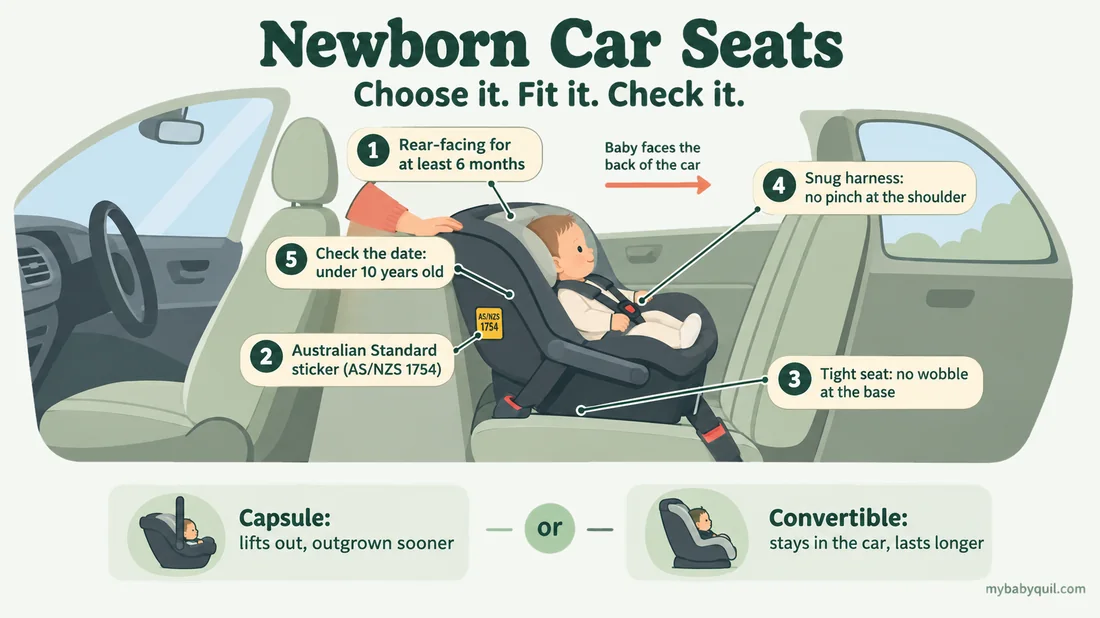
One of the most important jobs for new dads is buying and fitting the car seat, and it cannot wait, because your baby needs it for the very first trip home. The market is full of options, which creates confusion: capsule or convertible, what the sticker means, star ratings, how long to stay rear-facing. Different countries have different rules, so this article focuses mostly on the Australian standard, covering the types, how to fit a seat properly, and the mistakes parents make most. If you live elsewhere, check your own country's standard and road rules.
A newborn needs an approved rear-facing restraint with an inbuilt harness, carrying the Australian Standard sticker, fitted correctly every trip. This is general information, not legal or medical advice. Road rules differ by state and territory and can change, so check your transport authority. Always follow your seat's manual and your vehicle's manual.
| Your question | The short answer |
|---|---|
| Which seat does a newborn need? | A rear-facing seat with an inbuilt harness that carries the Australian Standard sticker (AS/NZS 1754). Babies must be rear-facing for at least their first 6 months. |
| Capsule or convertible? | Both are legal for a newborn. A capsule is outgrown sooner; a convertible lasts longer but can be bulkier to carry. |
| How long should they stay rear-facing? | Until their shoulders reach the top shoulder marker, not until they reach a certain age. |
| How long does a seat last? | Queensland recommends one under 10 years old. The manufacture date is on the sticker. |
| Can I use a seat bought overseas? | Not unless it meets AS/NZS 1754. Check for the sticker. |
| Is second-hand OK? | Only if you know its full history. Avoid seats that are old, crashed, recalled or without a date. |
| Can my baby sleep in the seat? | Only while travelling. Take them out as soon as you arrive, and on long trips stop for regular breaks. |
Short answers from the sources at the foot of the page. Age bands above are minimum legal requirements, not a signal to move up as soon as a birthday arrives. Some rules vary by state.
In Australia, children up to age seven must travel in an approved child restraint, correctly fastened and adjusted. Queensland's road rules say the restraint must carry the Australian Standard sticker (AS/NZS 1754), and the rule applies whenever the vehicle is moving or stationary but not parked. The Raising Children Network advises that babies stay rear-facing with an inbuilt harness for at least their first six months, using either an infant capsule or a convertible seat set to rear-facing.
Road rules are set by each state and territory, so detail such as who may sit where, taxis and rideshare differ. Check your own transport authority, for example Queensland, New South Wales or Victoria. The national minimum is the Australian Standard and the age bands; seating positions, taxis and rideshare are state matters.
Parents often assume there is a "newborn seat" and a "baby seat". In fact there are two ways to go rear-facing, and both pass the same standard.
| Infant capsule | Convertible seat | |
|---|---|---|
| Fits from | Birth, until the shoulders reach the top marker, often around the first year or sooner | Birth (check the minimum) and often up to around 2 to 4 years, rear then forward-facing |
| Carrying | Many lift out and can click onto a pram frame | Stays in the car |
| Cost over time | You will probably buy a second seat | One seat can cover several years |
| Newborn fit | Often snug for small babies | Check the minimum weight or size and head support |
| Hire | Often an option, because babies outgrow capsules quickly | Less common |
There is no single winner. If you carry a sleeping baby in and out a lot, a capsule is handy. If you want to buy once, a convertible suits. Either way, try fitting it in your own car before you commit, because seats fit some vehicles better than others.
RACV lists a dozen frequent errors. These are the ones that catch new parents most.
Back seat is the safest place for any baby. Rear-facing seats must never be used in front of an active airbag. Check your vehicle's manual. In most states, children under four may not sit in the front row of a vehicle with two or more rows, but check your own state.
Rules for taxis and rideshare vary between states and territories. Do not assume the law lets you skip a restraint. Check your state's transport authority, and carry your own seat if you travel by rideshare often.
Follow the manual, and if you are unsure, use a qualified fitting service. Transport Victoria says trained fitters can install the restraint, check it and show you how to adjust it, with fitting stations through RACV, Kidsafe Victoria and the Australian Child Restraint Resource Initiative. Other states have similar services. Book before your due date, not after.
The Queensland Government says not to use a restraint that has been in a crash. A seat can be damaged without looking it, so replace it.
Some small babies need their fit checked before they leave hospital. Ask the hospital team about the seat and how long your baby can safely travel.
Information is drawn from state government transport pages, the Raising Children Network, RACV and Red Nose. Rules change, so confirm with your state authority.
This page is for general information and does not replace the manual for your seat or vehicle, a professional fitting, or your state's current road rules.
BabyQuil is a free iOS app for pregnancy and newborn tracking. Add your due date and keep notes on appointments, questions for your midwife and things to sort before the birth.
Get BabyQuil — free on iOS