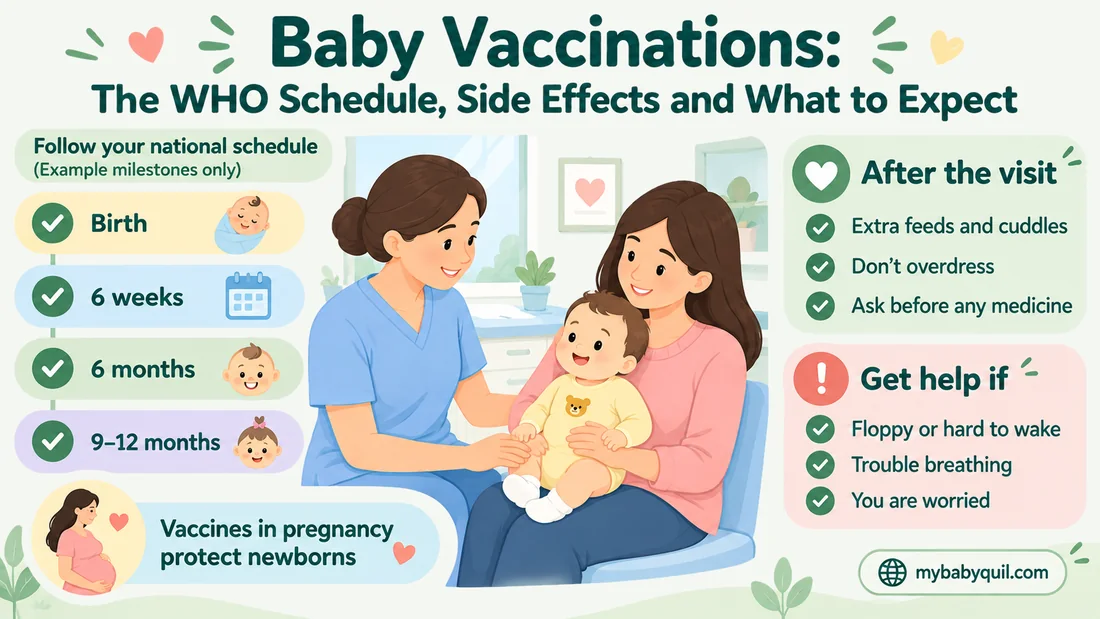
Your baby's first vaccine is given at or soon after birth, and several more follow in the first year. This guide is based on the World Health Organization (WHO) recommendations, explains what the vaccines protect against, and covers safety, what is normal afterwards, when to get help and how to keep the record. National schedules differ in their details, so use it alongside the schedule from your own health service.
| Your question | The short answer |
|---|---|
| What does WHO recommend? | A schedule of vaccines from birth, with the main infant series starting from 6 weeks of age. Countries adapt it to their own needs. |
| When is the first vaccine? | At birth: hepatitis B within 24 hours, and BCG where tuberculosis is common. |
| Which schedule should I follow? | Your own country's. WHO says its tables are for planners, and health workers should follow the national schedule. |
| Is it safe to give several vaccines at once? | Yes. WHO considers combination vaccines, and several vaccines in a single visit, to be safe and just as effective as separate shots. |
| What if my baby is a little late? | Resume the schedule. WHO says a delayed DTP series should resume without repeating doses. Ask your nurse about catch-up. |
| What are common side effects? | A fussy or drowsy baby, and a sore, red or puffy spot on the leg. Usually gone within a day or two. |
| When do I get help? | If your baby is floppy, very drowsy, has trouble breathing, or you are worried. |
| Where do I keep the record? | In your child's health card or record book, or your country's register if it has one. |
Babies are at their most vulnerable when they are youngest, and several of the diseases on routine schedules are serious in infancy. WHO says childhood vaccines alone save over 4 million lives every year, and that delaying vaccination leaves people at risk of serious illness. WHO's 2025 coverage figures show the gap that remains: about 85% of infants received three doses of DTP vaccine, and 13.5 million children received no vaccine at all. Protection also builds across a community, which is why every on-time dose matters.
WHO publishes a summary of recommended routine childhood immunisations, last updated in December 2025. It is written for planners who design national schedules, not for parents, and WHO says health workers should follow their national schedule. That is the schedule your nurse will use. The table below summarises WHO's recommendations for all children, so you can see the pattern and recognise the vaccines when they appear.
| Age (WHO) | Vaccine | Protects against |
|---|---|---|
| Birth | Hepatitis B (within 24 hours) | Hepatitis B |
| Birth | BCG, where TB or leprosy is common | Tuberculosis |
| Birth | Oral polio (bOPV), in polio-endemic or high-risk settings | Polio |
| From 6 weeks | DTP-containing vaccine, 3 doses at least 4 weeks apart, ideally finished by 6 months | Diphtheria, tetanus, whooping cough (often combined with hepatitis B and Hib, and sometimes polio) |
| From 6 weeks | Hib | Hib meningitis and pneumonia |
| From 6 weeks | Pneumococcal conjugate (PCV), 3 doses or a 2+1 schedule | Pneumococcal pneumonia, meningitis and other infections |
| From 6 weeks | Rotavirus, 2 or 3 doses depending on the product, not after 24 months | Severe diarrhoea from rotavirus |
| From 6 weeks | Polio (oral, injected, or both), several schedule options | Polio |
| 9 or 12 months | Measles and rubella (first dose); second measles dose at 15 to 18 months in high-transmission settings | Measles, rubella |
| 12 to 23 months | DTP booster | Diphtheria, tetanus, whooping cough |
Many countries combine the DTP, hepatitis B and Hib vaccines into a single injection to reduce the number of needles, sometimes adding polio as well. Your clinic will tell you which combination it uses.
WHO also recommends some vaccines only where the disease is a local risk. These depend on where you live or travel.
| Vaccine | Age (WHO) | Where it applies |
|---|---|---|
| Malaria | From 5 months, 4 doses | Areas with moderate to high malaria transmission |
| Yellow fever | 9 to 12 months, with measles vaccine | Countries or regions where yellow fever occurs |
| Japanese encephalitis | Inactivated vaccine from 6 months; live vaccines from 8 to 9 months | Endemic areas |
| Meningococcal | MenA conjugate at 9 to 18 months; others vary by product | Regions with meningococcal disease, for example the African meningitis belt |
| Typhoid (conjugate) | From 6 months, 1 dose | High-risk populations |
| Seasonal flu | From 6 months; 2 doses at least 4 weeks apart in the first season for ages 6 months to 8 years | Programmes that include it |
The same diseases are covered, but timing and choices differ, because countries set schedules around local disease burden, the vaccines they can supply and their health systems. WHO's own table shows this. BCG is a universal birth dose where TB or leprosy is common but used selectively elsewhere. Measles starts at 9 months where the disease spreads easily and at 12 months where it does not. Pneumococcal vaccine can follow a 3-dose or 2+1 schedule.
An example: Australia. Its schedule starts with hepatitis B at birth, then a combined 6-in-1 vaccine, a pneumococcal vaccine and rotavirus drops from 6 weeks, repeated at 4 and 6 months (with extra doses for some babies), then measles-mumps-rubella and other vaccines at 12 and 18 months, according to the NSW and Victorian health departments. BCG is given there only to children under 5 travelling to high-TB countries (Victoria). Your country's schedule may look different, so use the one from your own health service.
Antibodies pass from mother to baby, which covers the baby in the early months until they are old enough for their own vaccines (Queensland Health). Which vaccines are recommended in pregnancy varies by country, but commonly include:
Ask your midwife or doctor early in pregnancy which of these are offered where you live.
Victoria's Better Health Channel explains that a baby may be fussier or sleepier than usual after a vaccine, and the area around the needle can be red, swollen or tender. These effects are usually mild and settle within a day or two. A small firm lump may remain for weeks or months, and it needs no treatment. Other national health services give similar advice.
Keep your baby's immunisation record safe, whether it is a paper card or booklet or a national register. It shows which doses were given and when the next ones are due, and you may need it for travel, childcare or school. In Australia, for example, the Australian Immunisation Register holds every vaccine your child receives and an Immunisation History Statement is available through myGov (healthdirect).
Don't panic if you miss an appointment. WHO says that for a delayed DTP series, you should resume without repeating doses, and it publishes separate guidance for interrupted or delayed immunisation. Speak to a health worker about catching up, because timing depends on the vaccine and your child's age. Some vaccines have strict age limits. WHO says rotavirus vaccine is not given after 24 months, and national schedules often set earlier limits for the first dose, so don't delay the early visits.
WHO's table gives the earliest recommended start and the minimum gap between doses, and it is written for planners. Countries choose their own visit dates and products within that framework, based on local disease risk. Follow your national schedule.
Not usually. The Better Health Channel says a small firm lump can stay for weeks or months and does not need treatment. See your doctor if it hangs around or you are concerned.
Ask your doctor or nurse. WHO notes, for example, that a hepatitis B birth dose given to a baby under 2,000 g does not count toward the primary series, so the series still has to be completed. Premature babies may also be offered additional vaccines (healthdirect).
Information is drawn from WHO's December 2025 recommendations and fact sheets, with examples from Australian health services. Schedules change, so check the current one for your country.
This page is general information and not medical advice. It does not replace advice from your doctor, nurse or health service, who can tailor it to your baby and your country's schedule.
The BabyQuil App is free for pregnancy and newborn tracking. Keep appointment dates and notes together, and share a report with your doctor or nurse.
Get BabyQuil — free on iOS