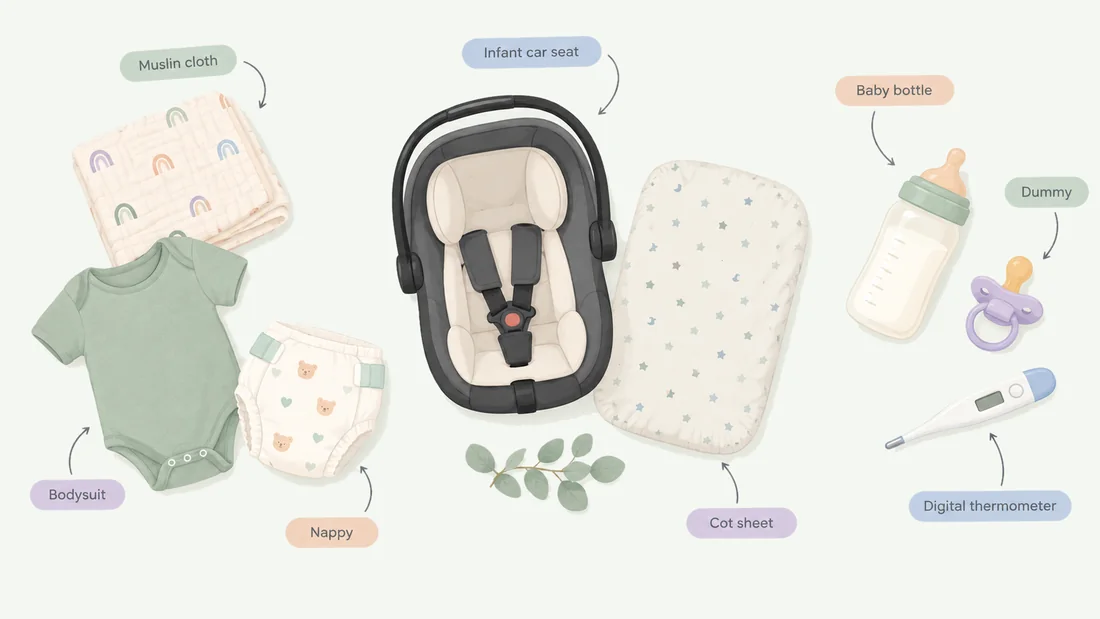
The honest answer is: less than the shops suggest. Here is newborn gear sorted into three piles, what to sort out now, what to wait and see on, and what you can delay or skip, with links to two deeper guides for feeding, travel, sleep and soothing.
This page is general information, not medical advice. What you need depends on your baby, how you feed, where you live and your budget. Safety standards also differ between countries, so check what applies where you live, and ask your midwife, child health nurse or doctor about anything specific.
| Item | What it's for | Who needs it | Need it now? |
|---|---|---|---|
| Car seat (infant restraint) | Safe travel in a vehicle, including the trip home. | Anyone travelling by car. It must meet your country's standard and be fitted correctly. | Essential |
| Cot or bassinet with a firm, flat mattress | A safe, bare place to sleep. | Every baby. Keep pillows, bumpers, loose blankets and soft toys out of it. | Essential |
| Nappies | Everyday care. | Everyone. Start with small packs, because babies differ. | Essential, in small amounts |
| Pram or stroller | Outings, walks and errands. | Most families. Try it out (fold it, lift it, push it) before you buy. | Needed by most |
| Bottles and teats | Feeding formula or expressed milk. | If you formula-feed or express. A few are enough to start. | Depends on how you feed |
| Sterilising equipment | Cleaning bottles, teats and pump parts. | Anyone using bottles, teats or a pump. | Needed if you use bottles |
| Breast pump | Expressing milk. | Not everyone. Useful if you are apart from your baby, engorged, or your baby can't latch. Can be hired. | Can wait. Ask first |
| Nipple shield | A soft silicone cover that can help a baby attach. | Only after a midwife, nurse or lactation consultant has assessed you and advised on size. | Only if advised |
| Baby carrier or sling | Hands-free carrying and settling. | Optional. Follow the T.I.C.K.S. safety checks. | Depends on you |
| Sleeping bag or lightweight wrap | Warmth without loose bedding. | Optional. Follow safe-wrapping rules and stop wrapping when your baby starts to roll. | Depends on you |
| Dummy | Settling and sleep. | A personal choice. If breastfeeding, wait until it is well established. | Depends on you |
| Baby monitor | Hearing your baby from another room. | Depends on your home. It doesn't replace safe sleep practices. | Can wait |
| Portable cot, high chair, change table, car seat capsule | Travel sleep, solids, nappy changes, a newborn-only car seat. | Later, or never. Buy when you know you need them. | Can wait |
The same list as a table. It is a starting point, not a shopping list. Your own needs, and your midwife's or doctor's advice, come first.
Almost everything on a baby registry is convenience. Two things are not: a car seat and a safe place to sleep. CHOICE, a consumer group, also names a cot with a mattress, a pram and nappies as the real must-haves.
Car seat. It needs to meet the standard where you live (in Australia, an Australian standard) and be fitted correctly. When you arrive, lift your baby out, even if they are asleep.
Sleep space. Red Nose advises a firm, flat mattress in a cot that meets your country's safety standard, your baby on their back with their face uncovered, and nothing soft in the cot. Keep the cot in your room for at least the first six months. Our guide to prams, carriers, safe sleep and soothing has the full list of what to include and leave out.
No gadget replaces rest and support. Say yes when someone offers help, and save your questions for your midwife, child health nurse or doctor:
In the early weeks it helps to have a record to look at when you are tired. The BabyQuil app lets you log feeds, nappy changes and sleep, see the patterns over days and weeks, and share a report with your doctor if you need to.
This overview draws on consumer guidance from CHOICE and on safe sleep guidance from Red Nose and the National Health Service (NHS). The two detailed guides list their own sources and show where recommendations differ between countries. We don't recommend specific brands.
This page provides general information and is not a substitute for personalized medical advice. Talk to your doctor, midwife or child health nurse about anything that concerns you or your baby.
Once your baby is home, BabyQuil's daily log is a simple way to see feeds, nappies and sleep settle into a pattern, with a report you can take to your child health nurse.
Get BabyQuil — free on iOS