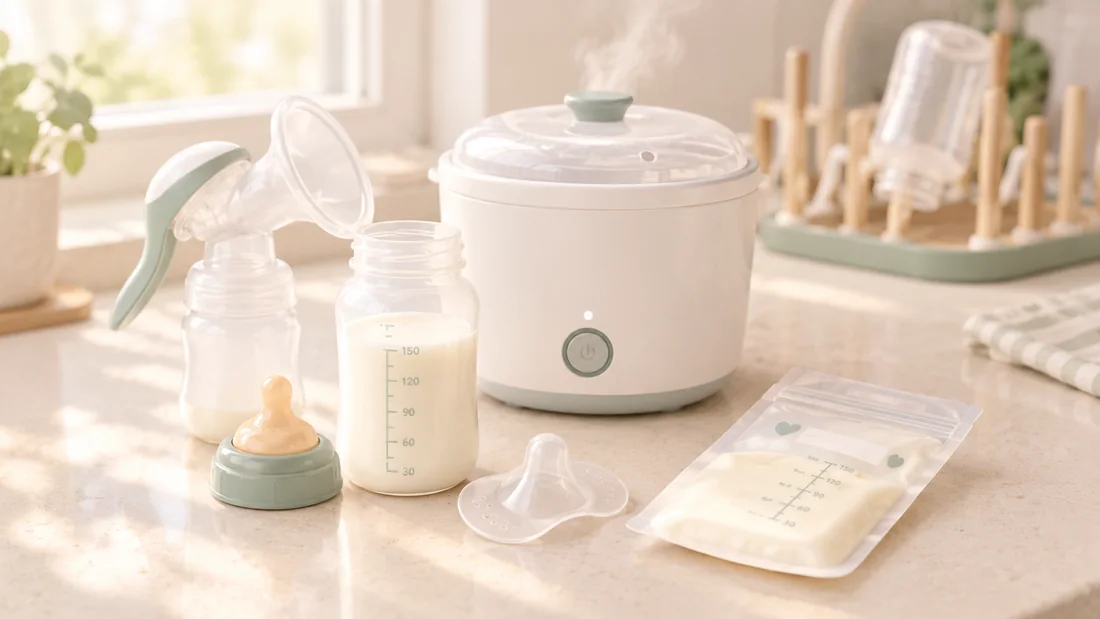
Do you need bottles? A pump now, or later? A nipple shield, yes, no, maybe? Feeding gear is the part of the newborn shopping list where people disagree the most, because it depends on how you feed. This guide starts there, then covers cleaning, formula, storing milk, pumps and nipple shields.
This is general information, not medical advice. Feeding doesn't always go to plan. If you are finding it hard, or your baby was born early or has specific feeding needs, ask your midwife, child health nurse, lactation consultant or doctor.
| Item | If you breastfeed | If you formula-feed | If you express or do both |
|---|---|---|---|
| Bottles and teats | Optional | Needed. A few to start | Needed. A few to start |
| Sterilising equipment | Only for bottles, teats or pump parts | Needed | Needed |
| Breast pump | Can wait. Ask your midwife first | Not needed | Often useful. Electric pumps can be hired |
| Milk storage containers or bags | Only if you express | Not needed | Needed, sterilised |
| Nipple shield | Only if a midwife or lactation consultant advises it | Not needed | Only if a midwife or lactation consultant advises it |
A guide to the usual set-up, not a shopping list. Your midwife's or doctor's advice comes first.
If you are breastfeeding, you may get by without any at first. If you will use formula or expressed milk, buy a few and add more once you know what your baby likes. Official guidance doesn't rank bottle or teat types, so the practical test is simply whether you can wash every part properly. Check teats regularly for tears and cracks, and replace any that are damaged.
The National Health Service (NHS) says to keep sterilising until your baby is at least 12 months old, and the Raising Children Network, an Australian parenting resource, says the same. If your baby was born early, is unwell or has specific feeding needs, ask your child health nurse or doctor what is right for you.
Health bodies don't agree on the water temperature, so here is how the two sets of guidance compare. Because the advice on water differs, follow your local health service and the instructions on the formula tin, and ask your child health nurse or doctor if you are unsure.
| Making up formula | Raising Children Network (Australia) | NHS (UK) |
|---|---|---|
| The water | Fresh tap water, boiled, then cooled to lukewarm (at least 30 minutes) | Freshly boiled tap water, left for no more than 30 minutes so it stays at 70°C or above |
| Order | Cooled water in the bottle first, then the powder | Hot water first, then the powder |
| The scoop | Use the scoop supplied, level it, and don't press the powder down | Use only the scoop supplied, and don't add extra powder |
| Left over | Throw away formula left in the bottle after one hour | Make up one feed at a time, and discard leftovers |
| Warming | Microwaves aren't recommended | Never warm a feed in a microwave |
Not necessarily. You can express by hand, which needs no equipment or electricity, and which can help with a blocked duct, although it takes practice. A pump speeds things up: manual pumps cost less but are usually slower, electric ones are faster, and you may be able to hire one through your midwife or a local breastfeeding supporter.
People tend to reach for a pump when they are apart from their baby, engorged, or their baby can't latch or suck well, or to build supply. Start on low suction and increase gradually, because strong suction from the start can hurt, and a pump should never bruise you. Most people can't tell whether they will need one until after the birth, which makes it one of the easiest purchases to delay.
Store milk in sterilised containers or breast milk storage bags. Recommended times differ between countries, as the comparison shows.
| Freshly expressed milk | Queensland Health | NHS |
|---|---|---|
| Room temperature | 6–8 hours (26°C or lower); refrigerate if possible | Not covered on the page we used |
| Fridge | No more than 72 hours (3 days) at the back, at 5°C or lower | Up to 8 days at the back, at 4°C or lower |
| Freezer compartment inside a fridge | 2 weeks | Fridge ice compartment: up to 2 weeks |
| Separate-door freezer | 3 months | Freezer at -18°C or lower: up to 6 months |
| Deep freezer (-20°C) | 6–12 months | Not covered on the page we used |
Queensland Health adds that milk thawed in the fridge can be kept there for 24 hours and should not be refrozen, and that milk left over after a feed should be thrown away. Follow your local health service's advice, and label and date what you store.
A nipple shield is a soft silicone cover worn over the nipple during a feed. A Queensland health service leaflet says one may help if a baby can't attach to the breast effectively, or if a premature baby has trouble staying attached. It advises speaking with a nurse, midwife or lactation consultant first, so they can check that milk is flowing well, show you how to apply the shield, and advise on size and type.
The leaflet also suggests checking that your baby is taking milk rather than only sucking on the tip, and that they are growing well, and it describes a gradual way back to feeding without the shield, with short, calm attempts. That is why a shield isn't a "just in case" purchase.
Struggling to get your baby to latch? Our guide on why your baby won't latch covers positioning, tongue-tie and when to call a lactation consultant. For the rest of the newborn list, see the newborn essentials overview and the guide to prams, carriers, safe sleep and soothing.
Questions worth taking to your midwife or child health nurse:
Writing feeds down makes those appointments easier. The BabyQuil app lets you log every feed, see the patterns over a day, week or month, and share a report with your doctor if you need to.
This guide draws on guidance from the NHS, Australian health services and the Raising Children Network, and shows where they differ. Storage times, water temperature and sterilising advice can change and vary by location, so confirm with your own midwife, child health nurse or doctor. We don't recommend specific brands.
This page provides general information and is not a substitute for personalized medical advice. Ask your doctor, midwife, child health nurse or lactation consultant about feeding questions that are specific to you and your baby.
Breast, bottle or both, BabyQuil records each feed so you can answer “how much, and how often?” at your next check-up without relying on a tired memory.
Get BabyQuil — free on iOS