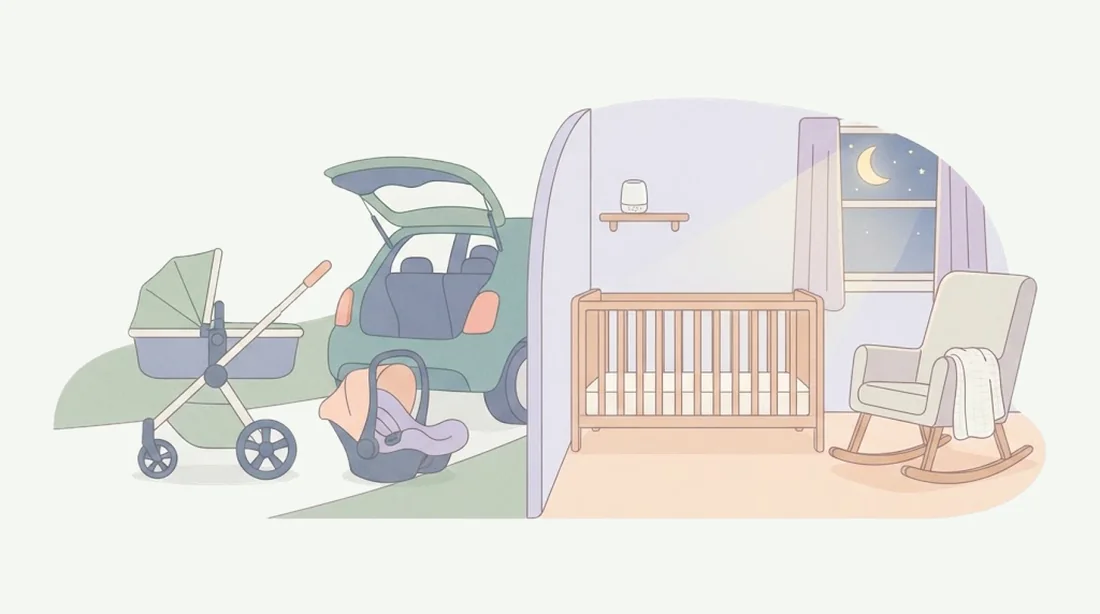
With a newborn, the gear that gets you out the door, helps your baby sleep and calms them down comes with the most safety rules. So this guide leads with the checks, not the shopping: what to look for, what to avoid, and which warning signs always need urgent care.
This is general information, not medical advice. Safety standards and recommendations differ between countries, so check what applies where you live. For anything specific to your baby, ask your midwife, child health nurse or doctor.
| Item | The key check | What to avoid |
|---|---|---|
| Car seat | Meets your country's standard, is fitted correctly, and your baby comes out when you arrive. | Leaving a sleeping baby in the seat for long periods. |
| Pram | Try folding, lifting and pushing it before you buy. | Covering it with a blanket or cloth, which can reduce airflow and raise the temperature. |
| Carrier or sling | T.I.C.K.S.: tight, in view, close enough to kiss, chin off chest, back supported. | Feeding your baby in the sling, or letting fabric cover their head. |
| Cot or bassinet | Baby on their back, face uncovered, on a firm, flat mattress. Keep it in your room for the first six months. | Pillows, duvets, loose blankets, bumpers, soft toys, pods or nests. |
| Wrap or sleeping bag | A lightweight wrap with no added fasteners, or a sleeping bag with a fitted neck and armholes. Stop wrapping when your baby starts to roll. | Hooded bags, oversized armholes, and extra blankets over a sleeping bag. |
| Dummy | Keep it clean, and plan to stop between six and 12 months. | Starting early if you are breastfeeding and it isn't yet well established. |
| Baby monitor | Optional, depending on your home. | Relying on it as a safety measure. It doesn't replace safe sleep practices. |
Treat this table as a starting point rather than a shopping list; your midwife's or doctor's advice comes first.
In Australia, Red Nose notes that it is a legal requirement to carry a baby in a correctly fitted infant restraint that meets an Australian standard. Other countries have their own rules. Wherever you live:
The National Health Service (NHS) says it is fine for your baby to doze in a car seat while you travel. Red Nose adds that long stretches in a sitting position can raise the risk of sudden infant death, and that the neck can bend forward. The consumer group CHOICE points out that a newborn-only capsule is usable for only about six months, so weigh the cost against a seat that grows with your child.
CHOICE lists a pram as a must-have for most families. Handling matters more than features, which is why the shop test is worth doing. A sunhat or a breathable mesh shade is a safer choice than a cover, according to Red Nose. A pram is made for outings, and guidance on sleeping in one varies, so follow your local safe-sleep advice.
A carrier can free your hands and settle a fussy baby. Whatever you choose, the NHS suggests running through T.I.C.K.S. every time you use it, and it advises against feeding your baby while they are in a sling.
For wraps, Red Nose recommends a lightweight one, and says to stop wrapping once your baby starts to roll. A sleeping bag should have a fitted neck and armholes and a suitable tog rating (a measure of warmth, short for thermal overall grade). Dress your baby in light layers.
Room temperature advice differs. Red Nose says there isn't a specific temperature recommended, and suggests dressing your baby for the room and checking their back or tummy, not their hands or feet. The NHS suggests keeping the room between 16°C and 20°C. Either way, aim for a baby who is comfortably warm, not overheated.
Red Nose doesn't promote baby monitors as a way to reduce the risk of sudden unexpected death in infancy, and says there is no evidence that they do.
Babies cry because they are hungry, have a wet or dirty nappy, are tired, want a cuddle, have wind, are too hot or cold, or are bored or overstimulated. The NHS says crying tends to peak at around two weeks and ease by about three months, and evenings are often hardest. Things to try:
Most of this is free. A bouncer, a white noise machine or a dummy are optional extras.
On dummies: a hospital trust leaflet calls it the parents' choice. If you are breastfeeding, it says dummies aren't generally recommended while feeding is being established, because they can interfere with learning to feed. The NHS says to consider one at the start of sleep, since some research suggests it may lower the risk of cot death. Unless a dummy is sterilised properly, it can cause infection.
If you feel overwhelmed and have no one to help, put your baby somewhere safe, such as a cot, step out of the room and calm yourself for a few minutes before going back. Never shake a baby.
For feeding gear, see our guide to bottles, sterilising, pumps and nipple shields. For the big picture, start with the newborn essentials overview.
A record helps when you are tired. The BabyQuil app lets you log feeds, nappies and sleep, view patterns over days and weeks, and share a report with your doctor.
This guide draws on guidance from Red Nose Australia, the NHS, healthdirect and consumer guidance from CHOICE, and shows where recommendations differ between countries. Standards and safety advice can change and vary by location, so confirm with your own midwife, child health nurse or doctor. We don't recommend specific brands.
This page provides general information and is not a substitute for personalized medical advice. Ask your doctor, midwife or child health nurse about anything that worries you or your baby.
Log sleep and feeds in BabyQuil so you aren't relying on memory when the nurse asks how the week has gone.
Get BabyQuil — free on iOS