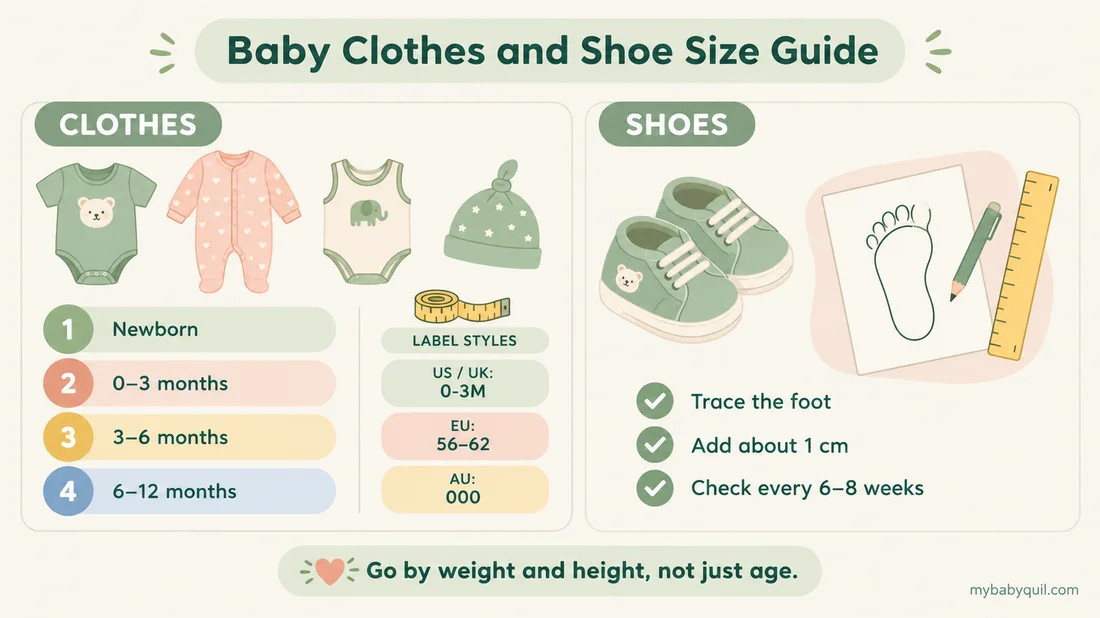
One week the newborn outfits swim on your baby, and the next the poppers won't close. This short guide helps you pick the right size, know when to size up, and work out when your little one needs their first pair of shoes.
Babies grow fast, and a size label gives you only a rough idea. One brand's 3 to 6 months is another's 0 to 3, and a chunky baby and a long, lean baby can be the same age and need different sizes. The good news is that two simple measures, weight and height, get you most of the way there.
Each region labels baby sizes differently. The US and UK use months (0-3M, 3-6M and so on), Europe uses your baby's height in centimetres, and Australia uses numbers, with lots of zeros for the smallest sizes. The chart below lines them up. Weights and heights are from Primark's UK size guide, the EU column from European height sizing, and the Australian numbers from Australian brand charts, where one or two sizes can shift between brands.
| Age | US / UK | EU (height, cm) | Australia | Weight | Height |
|---|---|---|---|---|---|
| Premature | Preemie | up to 44 | 0000000 to 00000 | varies by brand | varies by brand |
| Newborn | Newborn | 50 to 56 | 0000 | up to 3.6 kg | up to 54 cm |
| 0 to 3 months | 0-3M | 56 to 62 | 000 | 3.6 to 5.7 kg | 54 to 61 cm |
| 3 to 6 months | 3-6M | 62 to 68 | 00 | 5.7 to 7.7 kg | 61 to 69 cm |
| 6 to 9 months | 6-9M | 68 to 74 | 0 | 7.7 to 9.5 kg | 69 to 72 cm |
| 9 to 12 months | 9-12M | 74 to 80 | 0 (some brands 1) | 9.5 to 11.3 kg | 72 to 78 cm |
| 12 to 18 months | 12-18M | 80 to 86 | 1 | 11.3 to 12.7 kg | 78 to 83 cm |
| 18 to 24 months | 18-24M | 86 to 92 | 2 | 12.7 to 13.6 kg | 83 to 86 cm |
These are approximate retailer ranges, not a standard. The same brand's bodysuit, sleepsuit and jacket can even fit differently. If your baby is between sizes, go by whichever of weight and height is larger, and compare the brand's own measurements. Primark's size guide also suggests allowing for your baby's growth rate, the style of the garment and the nappy underneath.
Babies cannot tell you, so look for these signs:
A little extra length is a good thing. You can fold the cuffs on sleeves and legs to get more wear, and pieces with several rows of poppers adjust as your baby grows (Primark size guide). For what to dress your baby in at night, see our safe sleep guide.
Mostly, no. A podiatry leaflet from an NHS community service says a child does not need shoes until they start walking, and soft shoes are optional for warmth and protection outdoors. Before that, socks, booties or soft pre-walker shoes are enough. A first proper shoe is usually needed around the first independent steps, which for most children come somewhere between about one and two and a half years, according to the Royal College of Podiatry (UK).
Shoe sizing is even less standard than clothing, because each country and brand uses its own numbers. The table below is an Australian retailer's chart, to use as a guide only. Measure your child's foot from heel to the tip of the longest toe, add about 1 cm for growing room, and compare that with the "shoe length" column. The age column is only a rough illustration, because feet vary a lot at any age. Check the maker's own fitting instructions before you buy.
| Age (approx.) | Shoe length | AU / UK size | EU | US |
|---|---|---|---|---|
| 6 to 12 months | 11.8 cm | 3 | 19 | 4 |
| 12 to 18 months | 12.6 cm | 4 | 20 | 5 |
| 18 to 24 months | 13.4 cm | 5 | 21 to 22 | 6 |
| 2 years | 14.2 cm | 6 | 23 | 7 |
| 2.5 years | 14.6 cm | 7 | 24 | 8 |
| 3 years | 15.6 cm | 8 | 25 to 25.5 | 9 |
The Royal College of Podiatry also suggests skipping novelty designs with flashing lights, letting new shoes be worn around the house first, and avoiding socks that are too short or tight.
Toddler feet grow quickly. Both the Royal College of Podiatry and an NHS leaflet recommend checking fit about every six to eight weeks. Press gently to feel where the toes sit, and look for red marks, or a child who suddenly dislikes putting shoes on.
Sizes come from retailer size guides, which differ from one another, with fitting advice from the Royal College of Podiatry and an NHS leaflet. Always check the chart of the brand you are buying.
This page is general information and not medical advice. If you are worried about your child's feet or how they walk, speak to your doctor, child health nurse or a podiatrist.
The BabyQuil App is free for pregnancy and newborn tracking. Keep your baby's notes and appointments together as they grow.
Get BabyQuil — free on iOS