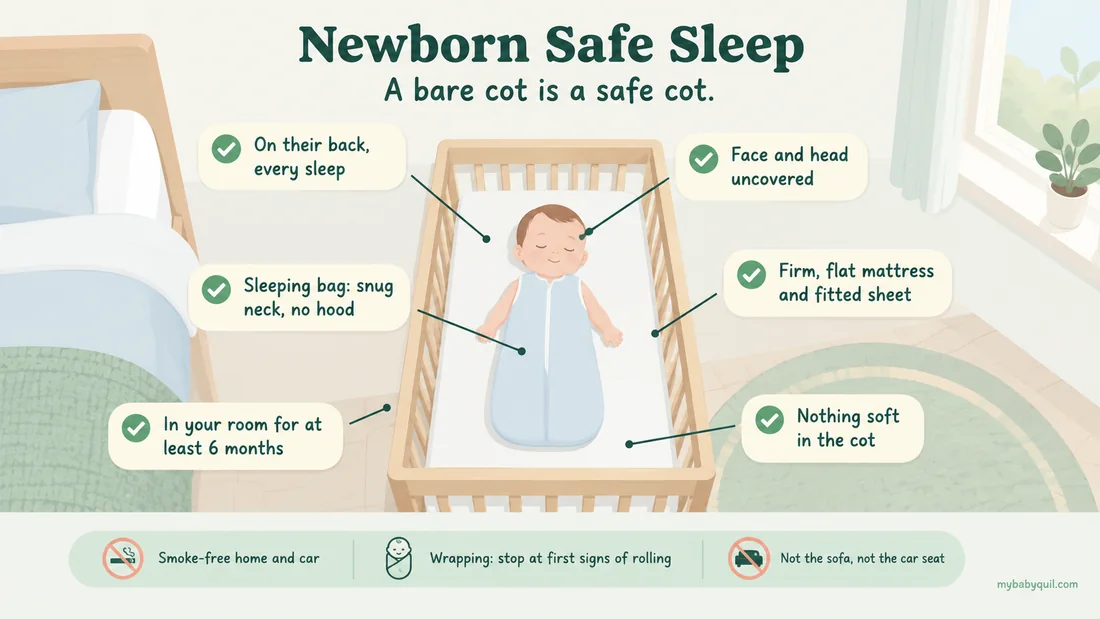
Safe sleep is the part of newborn care where details matter most, and the internet is full of conflicting advice. This guide focuses on Australian guidance from Red Nose and the government, and shows where the UK (NHS, Lullaby Trust) and US (AAP) advice agrees or differs, so it works wherever you live.
Place your baby on their back, in their own cot on a firm, flat mattress in your room, with face and head uncovered, nothing soft in the cot, and a smoke-free home. This is general information, not medical advice. If you are unsure about your baby's sleep, talk to your midwife, child health nurse or doctor.
| Your question | The short answer |
|---|---|
| What position should my newborn sleep in? | On their back, for every sleep. Side sleeping is as risky as tummy sleeping. |
| Where should they sleep? | In their own safe cot in your room for at least the first 6 months (Red Nose, NHS, AAP). Australian government guidance from Starting Blocks says 6 to 12 months. |
| Can they sleep on the sofa with me? | No. Do not sleep with a baby on a sofa, armchair or couch. |
| Is a pillow, bumper or soft toy OK? | No. Keep the cot clear. Soft toys and comforters are not recommended until about 7 months corrected age. |
| When do I stop wrapping? | As soon as your baby shows signs of rolling. Then use a sleeping bag with arms free. |
| How warm should the room be? | Dress them for the room. Check the chest or back of the neck. The UK suggests 16 to 20°C; Red Nose gives no set number. |
| Is a car seat or capsule a safe bed? | No. Use it for travel, then move your baby to a flat, firm surface. |
| Do nests, pods and inclined sleepers help? | No. Red Nose says there is little evidence they help, and they carry risks. |
Where countries differ, the comparison table below says so.
Safe sleep is mostly about what you leave out. Australia's Red Nose has six core messages, and the UK's NHS and Lullaby Trust and the US American Academy of Pediatrics (AAP) say much the same: baby on their back, a clear flat cot, in your room, smoke-free, and nothing that covers the face. The details that differ between countries are in the comparison table further down.
Advice for sudden infant death syndrome (SIDS) and sudden unexpected death in infancy (SUDI) applies to every sleep, including naps. The Lullaby Trust says to follow it until your baby is 12 months old, counted from the due date if your baby was premature.
Back sleeping applies to naps and night. Always start on the back. The AAP recommends supervised tummy time while your baby is awake, building up gradually, because it helps development. Tummy time is for waking hours only.
In your room. The cot goes in your room for the early months. Red Nose advises a safe sleep space in the same room for at least the first 6 months, and the NHS and AAP say the same. Starting Blocks, an Australian Government resource, describes 6 to 12 months. Follow the current advice from your local health authority.
In your bed. Red Nose says the safest place is their own safe sleep space and does not recommend co-sleeping, while acknowledging some families do it by choice or fall asleep by accident. It lists situations of increased risk: a parent who is overly tired, has had alcohol or drowsy-making drugs or medicines, or smokes, or a baby who is premature or small. The AAP is firmer and advises against bed-sharing altogether, and the NHS lists similar risk situations. If it will happen, Red Nose says to keep the baby on their back on a firm flat mattress, beside one parent and never between two adults or next to other children or pets, with pillows and bedding clear of their face.
On the sofa or armchair. Never. The NHS and Starting Blocks both say not to sleep with a baby on a sofa or armchair, so if you feel drowsy, put the baby in their cot first.
In a car seat, capsule or pram. Red Nose says never to leave a baby to sleep in a car seat, because the curved upright position can let the chin drop to the chest and block the airway. Take your baby out as soon as you arrive. See our guides to newborn car seats and prams and strollers.
Overheating is a risk, and babies lose heat through their head and face, so keep them uncovered. Red Nose says to feel your baby's chest or back, not hands and feet, which are often cool. The NHS and Lullaby Trust give a UK room range of 16 to 20°C, while Red Nose gives no set temperature because no evidence links one to preventing SUDI. No single temperature guarantees safety, so keep checking your baby. The AAP says to avoid hats indoors and to dress your baby in one more layer than an adult would be comfortable in. Keep cots away from heaters and direct sun.
Many baby products tilt or cradle a baby. Red Nose says an incline can let the head fall forward and block the airway, that a rolling baby on an incline can suffocate against a soft or padded surface, and that harnessed products carry a risk of entrapment. They are fine for watched, awake time, never for sleep. The Lullaby Trust says to avoid pods and nests, and the AAP says to skip inclined sleepers and any product not made for infant sleep. Reflux is a common reason for using a wedge, but Red Nose says there is little evidence it helps. The ACCC advises placing infants to sleep only on a flat, firm surface.
Premature and low birth weight babies are more vulnerable, so keep following safe sleep advice for 12 months from the due date, not the birth date, according to the NHS and Lullaby Trust. The NHS also says not to bed-share if your baby was born before 37 weeks or weighed under 2.5 kg.
Red Nose says a dummy used at every sleep is associated with lower SIDS risk. Breastfed babies should wait until feeding is established, usually around 4 to 6 weeks, and you shouldn't force a dummy on a baby who refuses it. If it falls out during sleep, don't put it back in. Breastfeeding at any amount is linked with lower risk, according to the Lullaby Trust. Our soothing guide covers dummies in more detail.
The core message is the same everywhere. These are the points where the official sources we checked differ.
| Topic | Australia (Red Nose and government) | UK (NHS, Lullaby Trust) | US (AAP) |
|---|---|---|---|
| Room sharing | At least 6 months (Red Nose); 6 to 12 months (Starting Blocks) | At least 6 months | At least 6 months |
| Room temperature | No set figure; check chest or back | 16 to 20°C | One more layer than an adult; no hats indoors |
| Bed-sharing | Not recommended; lists high-risk situations | Lists high-risk situations; sofa is never safe | Advises against bed-sharing |
| Dummy | Wait until breastfeeding is established | Consider one; may lower risk | Offer at sleep once breastfeeding is established |
| Cot standard | AS/NZS 2172 (household), AS/NZS 2195 (portable) | Check your national standard | US Consumer Product Safety Commission rules |
If you live elsewhere, check your own country's health authority.
Information is drawn from Red Nose, the Australian Government, the NHS, the Lullaby Trust and the American Academy of Pediatrics. Advice can change, so check the current guidance from your local health authority.
This page is for general information and does not replace advice from your health professional. Safe sleep advice can change, so check your local health authority.
BabyQuil is a free iOS app for pregnancy and newborn tracking. Log sleeps, feeds and nappies, spot patterns over days and weeks, and share a report with your doctor or nurse.
Get BabyQuil — free on iOS