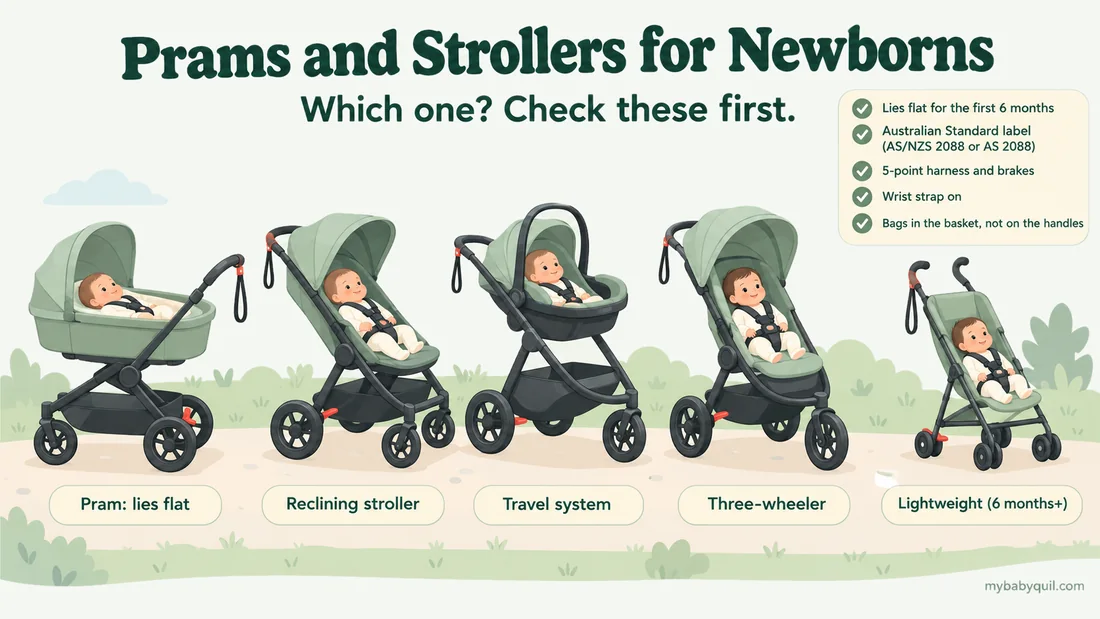
A pram is usually the biggest purchase after the car seat, and the shop floor is confusing: pram, stroller, travel system, jogger, three wheels or four. Different countries have different rules, so this article focuses mostly on the Australian standard. It covers the types, the one thing a newborn needs from any of them, what makes one comfortable, and the mistakes to avoid. If you live elsewhere, check your own country's standard.
For a baby under six months, choose a pram or reclining stroller that lets them lie flat, check for the Australian Standard label, and use the harness and brakes every time. This is general information, not medical or product advice. Always follow the manufacturer's instructions and weight limits, and keep your baby in sight.
| Your question | The short answer |
|---|---|
| Does it lie flat? | Babies should lie flat for at least their first 6 months. An upright stroller is not safe for a baby under 6 months. |
| Is there a standard label? | Look for AS/NZS 2088:2013 or AS 2088:2022. Prams and strollers sold here must meet a mandatory standard. |
| Is there a 5-point harness? | Yes, and use it every time. |
| Are the brakes and tether in order? | Red parking brakes your child cannot reach, and a wrist tether strap. |
| Does the frame lock? | The frame should lock when folded and open, with no gaps that could trap a head, limb or finger. |
| Where do bags go? | In the basket underneath, never hung from the handles. |
| Can my baby sleep in it? | If they fall asleep, stay with them and move them to a cot or other safe sleep surface as soon as practical. Never leave a baby alone in a pram. |
| Is second-hand OK? | Check for recalls and test that the harness, brakes and tether work. |
Short answers from the sources at the foot of the page.
The words are used loosely. Pregnancy, Birth and Baby describes a pram as fully reclined, for babies too young to sit unsupported, and a stroller as upright or adjustable, for older babies and toddlers. Many products are combinations with several seat positions. What matters for a newborn is the position, not the name on the box: can your baby lie flat, with a firm, level surface and good airflow?
For a baby under six months, that means either a pram or a stroller that reclines far enough. Pregnancy, Birth and Baby says a stroller for children under six months should recline to at least 130°. Limits differ by model and position, so check the manufacturer's age and weight limits for the bassinet, the reclined seat and the upright seat.
A shop checklist: Does it suit my baby's age and size? Does it carry the Australian Standard label? Can I use the brakes and harness easily? Can I lift, fold and steer it comfortably? Does it fit my car boot and my everyday routes? Are the manual and spare parts available?
A travel system lets you attach a compatible car capsule to a pram frame. That can make transfers convenient, but a capsule is not a substitute for a safe sleep surface. Red Nose advises that babies should not be left to sleep in a car seat beyond the journey, and that capsules should not be used as sleep devices at your destination. Follow the capsule and pram instructions, and move your baby to a safe, flat sleep surface as soon as practical after travelling.
Also check that your capsule is approved for the frame you have. The two have to match.
Buying second-hand can save money, but check it carefully. Pregnancy, Birth and Baby recommends checking for recalls, and that the harness, brakes and tether work. Look for the standard label, cracks, worn wheels and a frame that locks. If it has no label or the label is unreadable, it is a reason to say no. You can search recalls on the Product Safety Australia website.
Not necessarily. A reclining stroller that lies flat can carry a newborn and carry on for years. A separate pram suits families who want a flat, bassinet-style bed for the first months, but it is outgrown once your baby can sit unaided. Many families buy one combination model and add a lightweight stroller later.
Not always. The words on the box are marketing. Look at the seat or bassinet itself: does it recline far enough to lie flat or reach at least 130°, and is the surface firm and level? Check the label and the manual, and ask the retailer to show you.
No. The label is one part of checking a product. It does not show that a used pram is still safe today, so inspect the condition, recalls, brakes, harness, tether and locking latches as well. If the label is missing, treat that as a reason to look elsewhere.
For comfort and handling, yes. Larger wheels and suspension tend to cope better with paths and rough ground, while small wheels suit smooth shopping-centre floors. Try the pram where you will actually use it.
Often, with a second seat or a bassinet, but check the weight limit and that every part still works. A pram that has been in storage needs the same brake, harness and latch checks as a second-hand one.
Many parents use both. A carrier keeps your hands free and keeps your baby close, but it has its own safety checks. See our newborn essentials guide and, for carrier and sleep safety, our guide to prams, carriers, safe sleep and soothing.
Information is drawn from the Raising Children Network, Pregnancy, Birth and Baby, Red Nose and the Australian Government's mandatory standard.
This page is for general information and does not replace the manual for your pram or advice from a child health nurse or doctor.
BabyQuil is a free iOS app for pregnancy and newborn tracking. Keep your shopping questions and appointment notes in one place.
Get BabyQuil — free on iOS