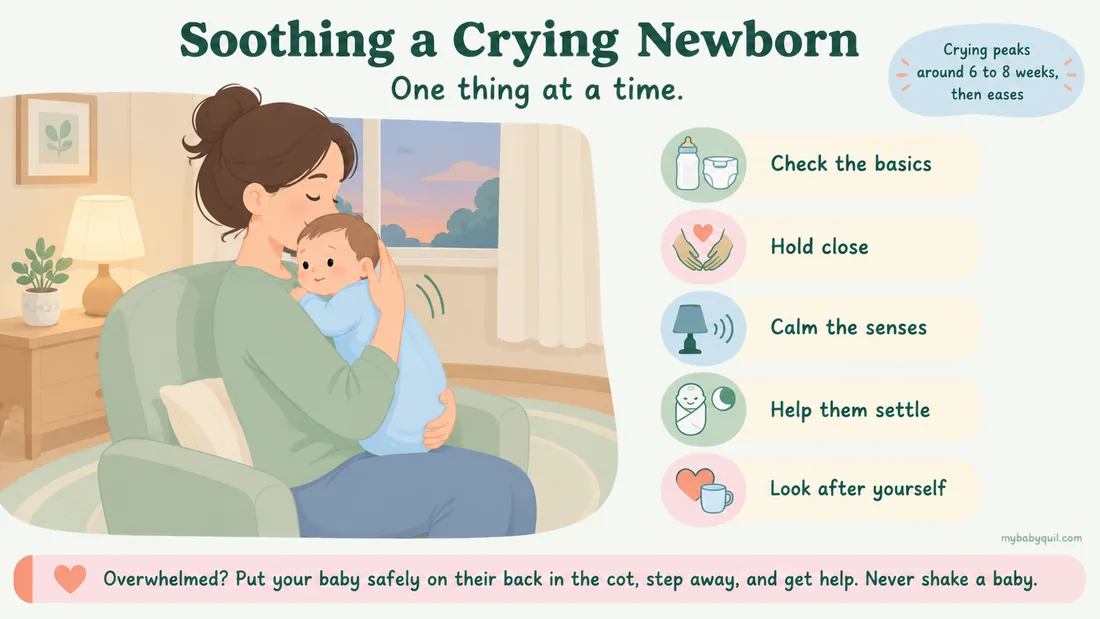
Every new parent meets the crying that won't stop. Here is how much is normal, a menu of things to try, what colic really is, and what to do when you reach your limit. Based mainly on Australian guidance, with advice from Ireland, and written to be useful wherever you live.
Most newborn crying is normal and peaks around six to eight weeks. Check the basics, try one soothing step at a time, and never shake a baby. If the cry sounds different, your baby seems unwell, or you can't cope, get help. This is general information, not medical advice.
| Your question | The short answer |
|---|---|
| How much crying is normal? | About 2 hours a day on average in the first 3 months. It usually peaks around 6 to 8 weeks and eases to about an hour a day by 12 weeks. |
| Why do newborns cry? | Hunger, tiredness, discomfort, a need for comfort, or illness. Most of the time there is no medical cause. |
| What is colic? | Crying for at least 3 hours a day, on at least 3 days a week, with no illness behind it. It affects around 1 in 5 babies. |
| Does it get better? | Yes. Crying often peaks in the first 6 to 8 weeks and usually eases after about 4 months. |
| Do colic remedies work? | Many have no proven benefit. Talk to your doctor or nurse before trying any. |
| Should I use a dummy? | It is a personal choice. Breastfed babies should wait until feeding is established, usually 4 to 6 weeks. |
| When should I see a doctor? | If the cry sounds different, your baby is not feeding or gaining weight, seems unwell, or you are not coping. |
| What if I feel I can't cope? | Put your baby safely in the cot, step away, breathe, and phone a helpline. Never shake a baby. |
Crying that won't stop is one of the hardest parts of the early weeks, and feeling overwhelmed is common. When you reach your limit:
In Australia, you can contact healthdirect (24-hour nurse advice), PANDA, Lifeline, Beyond Blue or your state or territory parenting line. If you fear you may hurt yourself or your baby, call your local emergency number. Elsewhere, contact your local emergency number, your doctor or your health service.
Crying is a baby's main way of telling you what they need or feel. The Raising Children Network says babies cry and fuss for about two hours a day on average in the first three months, about 2 in 10 cry for much longer, and crying usually peaks around six to eight weeks. The Royal Children's Hospital (RCH) adds that it is often worse in the late afternoon and evening and usually eases after about four months.
The causes are usually ordinary: hunger, tiredness, discomfort, a need for closeness, or too much stimulation. Check first that your baby isn't unwell or hurt (see the red box below).
Nothing works every time, so think of this as a menu. Try one thing at a time and give it a few minutes before switching.
The HSE notes that a crying baby may be overtired or overstimulated. Lay them on a mat beside you, turn down the lights and reduce noise.
The RCH describes a typical pattern of crying that is Peak (worst around six to eight weeks), Unexpected, Resistant to soothing, Pain-like in appearance, Long-lasting and Evening-weighted. Knowing that this pattern is common, and that it passes, can make it easier to cope with. Colicky crying can look as though your baby is in pain, even when a medical cause isn't found. Because crying can also be a sign of illness, seek medical advice if your baby seems unwell, the cry is unusual, feeding changes, or you're worried.
Raising Children defines colic as persistent crying and fussing with no illness or injury behind it: at least three hours a day, on at least three days a week. It affects about one in five babies, is most common in the first six weeks, and the cause is not known. Colicky babies may cry loudly, draw up their legs, squirm and strain, and be hard to comfort.
Red Nose says breastfed babies should wait until breastfeeding is established, usually around 4 to 6 weeks, while bottle-fed babies can be offered one from birth. Don't force a dummy on a baby who refuses it, don't put it back in if it falls out during sleep, clean and replace dummies regularly, and never coat one in anything sweet. Red Nose suggests starting to phase out dummy use after your baby turns one. For the safe sleep side, see our safe sleep guide.
We have drawn mainly on Australian sources, with advice from the HSE in Ireland. The core messages are the same wherever you live: crying is normal, never shake a baby, and ask for help early. Support lines differ by country, so check your own health service.
Information is drawn from the Raising Children Network, the Royal Children's Hospital Melbourne, Ireland's Health Service Executive and Red Nose. Contact your doctor or health service for personal advice.
This page is for general information and does not replace advice from your doctor, midwife or child health nurse. If you are worried about your baby or about hurting them, seek help immediately.
BabyQuil is a free iOS app for pregnancy and newborn tracking. Log feeds, sleeps and nappies so you can see patterns and share a clear record with your doctor or nurse.
Get BabyQuil — free on iOS