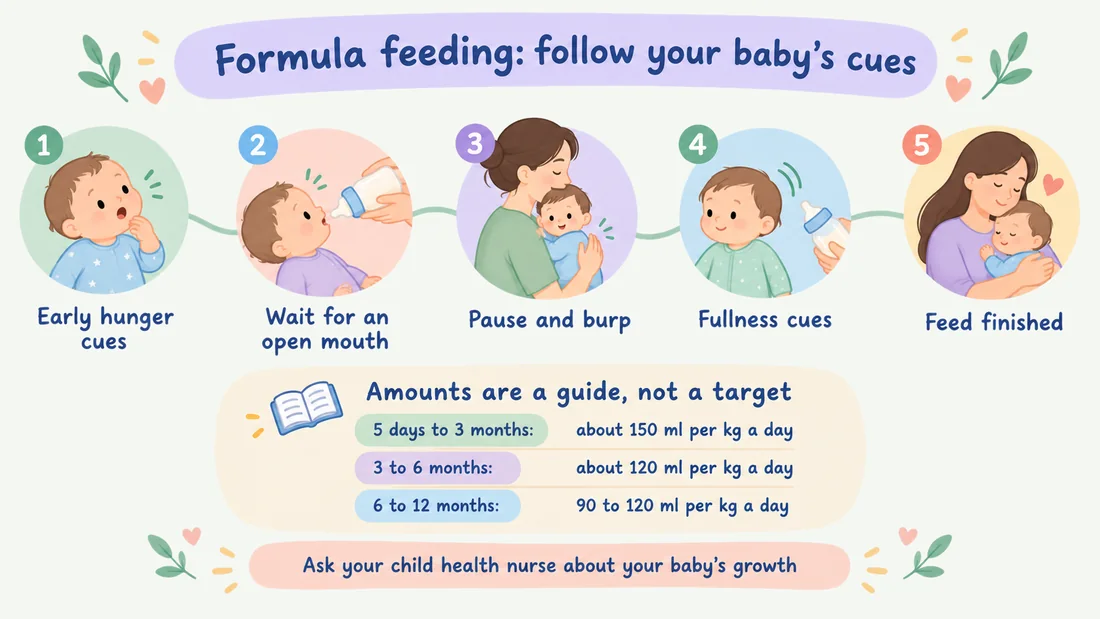
How much formula does a newborn need, how often, and how do you know they've had enough? The tin gives one guide, health services give another, and your baby gives the best clues. Here is what the guidance says, plus mixed feeding, wind, poo, vitamin D and the move from bottle to cup.
This is general information, not medical advice. Amounts below are guides, and babies vary. Your child health nurse can check your baby's growth and tell you whether feeding is on track. Contact a doctor or your health line if your baby is feeding poorly or seems unwell.
| Your question | The short answer | Where it comes from |
|---|---|---|
| How much does a newborn need? | About 150 ml per kilo of body weight a day from 5 days to 3 months, 120 ml from 3 to 6 months and 90 to 120 ml from 6 to 12 months. A guide, not a target. | Better Health Channel (Victoria) |
| How often should I feed? | Whenever your baby shows hunger cues. Little and often is normal, and babies don't always finish a bottle. | National Health Service (NHS) Wales, Grampians Health |
| How do I know they've had enough? | They turn away, frown, push the teat out or lose interest after a break and a second offer, and they gain weight steadily. Around six or more wet nappies a day is reassuring once feeding is established. | Better Health Channel, Children's Health Queensland |
| Can I mix breast and bottle? | Yes, but regular formula can make a good milk supply harder to keep up, so plan it with a midwife or nurse. | Raising Children Network |
| Does my baby need vitamin D? | Exclusively formula-fed babies usually don't need extra, because formula contains it. Some breastfed babies may need a supplement, so ask your GP or nurse. | North Metropolitan Health Service (WA), Better Health Channel |
| What water should I use? | Fresh tap water, boiled and cooled to lukewarm. Bottled water isn't automatically safer. | Better Health Channel, Raising Children Network |
| When should bottles stop? | Offer a cup from about 6 months, and aim to be off the bottle by 12 months. | Raising Children Network |
Short answers from the sources listed at the foot of the page. Australian and UK advice differ in places, and the sections below say where.
The Better Health Channel (Victoria) gives approximate daily amounts: about 150 ml of milk per kilo of body weight a day from 5 days to 3 months, 120 ml per kilo from 3 to 6 months, and 90 to 120 ml per kilo from 6 to 12 months. For a 3 kg baby in the first group, that is around 450 ml in 24 hours, shared across the day's feeds. It calls these amounts just a guide, and says some babies drink more or less. UK advice from NHS Wales uses a wider range of 150 to 200 ml per kilo until 6 months, and notes that illness, teething pain and growth spurts can change what your baby wants.
Treat the tin's feeding table as a rough guide only. The Better Health Channel says tin volumes are often more than your baby needs, and a 2021 paper in the Medical Journal of Australia found that manufacturers' guides vary, differ from national volumes and ignore weight, so a small baby could be overfed and a large baby underfed. Never pressure your baby to finish a bottle, and don't put your baby to bed with one. Grampians Health says feeding should follow your baby's hunger cues.
There is no fixed timetable. Grampians Health advises feeding whenever your baby shows signs of hunger, and notes that newborns take small amounts often and don't always finish the bottle. NHS Wales adds that a big feed doesn't mean your baby will go longer before the next one.
Early cues are restlessness, turning the head with an open mouth (rooting), and sucking on a fist or fingers. NHS Wales suggests feeding before your baby cries, because crying is a late sign. Children's Health Queensland points out that crying can also mean tiredness, boredom, discomfort or a wish for a cuddle, so a young baby may need calming first.
Responsive (sometimes called paced) bottle feeding lets your baby set the speed, which makes it easier for them to show when they need a break or have had enough.
Never prop up a bottle or leave your baby alone with one, because of the risk of choking.
Children's Health Queensland says fullness cues, steady weight gain and enough wet nappies are reassuring signs, and NHS Wales gives around six wet nappies a day from a few days after birth. In the first days after birth, nappy output changes day by day. Contact your midwife, child health nurse or doctor if your baby feeds poorly, has fewer wet nappies than expected, is unusually sleepy, or you are worried about weight gain.
The Raising Children Network defines mixed feeding as breastfeeding and giving infant formula, and expressed milk can replace some direct feeds. Families do it for many reasons: a baby born very early or not gaining well, a plan to build up supply, a return to work, or simple preference.
The North Metropolitan Health Service in Western Australia says babies who are exclusively formula-fed don't need extra vitamin D because formula contains it, and the Better Health Channel also notes that formula is fortified with it. Advice for breastfed babies varies: the Western Australian service recommends a daily supplement for all breastfed babies until at least 6 months, while the Better Health Channel lists babies of vitamin D-deficient mothers as being at greater risk. Ask your GP or child health nurse what applies to your baby, especially if you mix breast and bottle.
Burp your baby during a break, or hold them upright and gently rub or pat their back after the feed. Spilling is common, and the NHS says anti-reflux formula should only be used on a health professional's advice, so ask your nurse before trying one.
On poo, the Royal Children's Hospital in Melbourne says bottle-fed babies usually poo at least every one to three days, and that straining is common in babies under six months and is not constipation. Signs of constipation include tummy pain, a bloated belly, hard lumps and small splits around the bottom. It says a white, red or black poo needs a doctor, and that a constipated formula-fed baby might need a different formula, so see your GP or child health nurse first instead of switching yourself. Too much powder in a bottle is also linked to constipation, as covered in our infant formula guide.
Powdered formula isn't sterile. The Public Health Agency of Canada says it can carry bacteria such as Cronobacter, that newborns under four weeks old and premature babies are at highest risk, and that bacteria multiply quickly if mixed formula is left warm. That is why the steps matter: clean hands and surfaces, boiled water, feeding soon after making up, no reheating, and no leaving mixed formula at room temperature.
In Australia, the Better Health Channel and the Raising Children Network say to boil fresh tap water and let it cool to lukewarm, which takes at least 30 minutes. Cooled boiled water can be kept in sterilised bottles in the fridge for 24 hours. Bottled water isn't automatically safer: the NHS says it isn't usually sterile and may contain too much sodium or sulphate.
Don't assume a formula-making machine prepares a safe feed just because it dispenses water and powder. UK guidance relies on water at 70°C or hotter, and a 2023 Swansea University study found that 85% of the 74 machines tested didn't appear to reach it. That is a different method from the Australian one, so check the maker's instructions against Australian health advice, ask your child health nurse if you're unsure, and see our feeding gear guide for how the two methods compare.
The Raising Children Network says you can help your baby learn to use a cup from around 6 months, and recommends weaning off the bottle by 12 months. You can swap one bottle for a cup about every three days, leaving the bedtime bottle until last, or stop bottles all at once and offer a cup with each meal and snack. Avoid weaning during times of stress or change, such as starting child care.
Between 6 and 12 months, drinks can be breastmilk, infant formula and small amounts of cooled boiled tap water. From 12 months, the recommended drinks are breastmilk, full-fat cow's milk and tap water. Bottle-feeding after 12 months raises the risk of tooth decay, especially if a child goes to sleep with a bottle, and a lot of milk can reduce appetite for foods that provide iron and zinc.
For the types of formula and what the numbers on the tin mean, see the infant formula guide. For bottles and sterilising, see newborn feeding gear.
This guide draws on Australian health services alongside UK and Canadian guidance, and says where they differ. Amounts, schedules and water advice vary by country and can change, so confirm with your own midwife, child health nurse or doctor. We don't recommend specific brands.
This page provides general information and is not a substitute for personalized medical advice. Ask your doctor, midwife or child health nurse about feeding amounts and growth for your baby.
Log each bottle and nappy in BabyQuil and look back over days and weeks, so you can talk through the pattern with your child health nurse. It supports your check-ups, and doesn't replace them.
Get BabyQuil — free on iOS