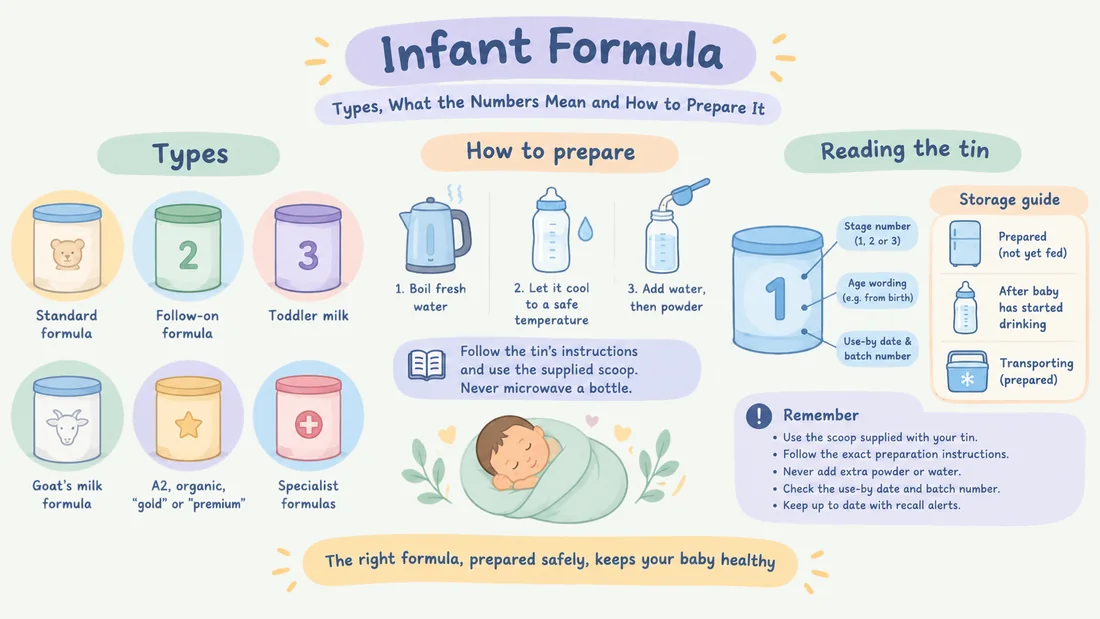
Walk down the formula aisle and you meet a wall of tins: stages, types, “gold”, “comfort”, “hungry”. Most of it is marketing, a little of it matters, and a few types are medical. Here is how to tell which is which, and how to make up a bottle without the common mistakes.
This is general information, not medical advice. If you formula-feed, top up or combine formula with breastfeeding, your midwife, child health nurse or doctor can help you choose, and they are your first call if your baby seems unsettled on a formula. Never make formula at home.
| Type | What it is | Usually suitable | Who decides |
|---|---|---|---|
| Standard cow's milk formula (stage 1, starter or newborn) | The most common type, and the one most babies need. | From birth, and safe to use up to 12 months. | You can choose |
| Follow-on formula (stage 2) | A formula made for older babies. It is not required. | From 6 months, never before. | You can choose |
| Toddler or junior milk (stage 3 and up) | Marketed to children over 12 months. | Healthy children generally don't need it. Food and full-cream cow's milk can do the job. | Usually skip |
| Goat's milk-based formula | Made to the same nutritional standards as cow's milk formula. | Same ages as standard formula. Not for cow's milk allergy. | You can choose |
| Organic, “gold” or “premium” ranges | Variations on cow's milk formula, usually at a higher price. | Same ages as standard formula. A higher price or marketing claim alone doesn't show an advantage for a healthy baby. | You can choose |
| Hungry baby, comfort, anti-reflux, lactose-free | Adjusted versions aimed at common worries such as wind, reflux and crying. | Evidence is thin. Anti-reflux and lactose-free are for medical use. | Ask first |
| Soy-based formula | A plant-based alternative. | Not under 6 months, and only on a professional's advice. | Ask first |
| Hydrolysed and amino acid formula | Milk proteins broken down, or replaced with amino acids. | For diagnosed allergy or medical need. The type depends on the condition, and some products have specific supply arrangements. | Medical supervision |
| Ready-to-feed liquid | The same kind of formula, already mixed. | Handy for travel. It costs more and must be used faster once opened. | You can choose |
A summary, not a recommendation. All infant formula sold in Australia has to meet the Food Standards Code, and no brand is endorsed here.
Three things on a tin are worth a proper look. None of them is the brand name.
Recalls are the reason to keep the tin: Food Standards Australia New Zealand (FSANZ) publishes current food recall alerts, and you can subscribe to its recall emails.
The big numeral on the front, usually 1, 2 or 3, is a stage label. It groups a brand's products by the age of the baby they are aimed at, and it sits next to wording such as “from birth” or “from 6 months”. The Sydney Children's Hospitals Network describes step one, starter, newborn or 0 to 6 month tins as safe to use from birth to 12 months, and step 2 or follow-on tins as being for babies over 6 months.
The Food Standards Code defines its categories by age and purpose rather than by number: infant formula from birth, follow-on formula from 6 to 12 months, and special medical purpose products for use under medical supervision. In practice the numeral is the brand's way of laying out its range. Food Standards Australia New Zealand (FSANZ) tightened how these products are told apart from toddler milks in September 2024, with a transition to September 2029, so labels may keep changing.
FSANZ's 2026 review of consumer research found that parents rely on the “suitable for ages” wording more than the number, and that some parents elsewhere read the numeral as a baby's age in months or years, or even a number of cups. So read the age wording. A tin marked 0 to 12 months is infant formula, whatever number it carries.
Not necessarily. The National Health Service (NHS) says there is no evidence that switching to follow-on formula at 6 months does any good or harm, and babies can stay on first infant formula until they are one. Follow-on formula should never be given before 6 months. The Tasmanian Department of Health advises avoiding switching where you can, because instructions differ between products and mistakes become easier.
Stage 3, toddler and junior milks are a different matter. The Sydney Children's Hospitals Network says babies don't need infant formula after 12 months, and that toddlers should get most of their nutrition from food, and can keep breastfeeding or drink cow's milk. The NHS says children aged 1 to 5 do not need formula milks.
Probably not. Most babies do well on a standard cow's milk formula, and the label claims on the others are often stronger than the evidence. The NHS says there is no evidence that babies settle better or sleep longer on a “hungrier baby” formula, and none for comfort formula preventing colic. The Sydney Children's Hospitals Network says “gold” or “optimum” formulas are not proven better than standard ones, and that evidence for formulas based on a particular milk protein being easier to digest is limited.
Some types are medical. Anti-reflux, lactose-free and soy formulas, and hydrolysed or amino acid formulas, are for use under medical supervision. If you suspect cow's milk allergy, don't try to fix it by swapping tins. The Australasian Society of Clinical Immunology and Allergy (ASCIA) lists extensively hydrolysed and amino acid formulas as suitable for cow's milk allergy, and lists partially hydrolysed, goat's milk and standard formulas, including anti-regurgitation, lactose-free, organic and specific milk-protein types, as not suitable. It also recommends seeing a paediatric allergy dietitian. Never make formula at home, because the Tasmanian Department of Health lists homemade infant formula as potentially unsafe.
The full method, and where Australian and UK advice on water temperature differ, is in our newborn feeding gear guide, and amounts and bottle technique are in the formula feeding guide. Here are the mistakes worth knowing about.
Keep sterilising bottle-feeding equipment until your baby is 12 months old. UK advice uses hotter water and a different order, so the two methods aren't interchangeable. Our newborn feeding gear guide has the full method and the comparison.
These are the Australian figures, from the Raising Children Network and the Sydney Children's Hospitals Network, which agree with each other. UK advice is stricter: the NHS says to make up one feed at a time and throw away what is left. When you are out, the Raising Children Network says the safest option is to carry cooled boiled water and powder separately and mix as needed, and ready-to-drink formula is another option. For car travel, see our guide to car seats, prams and safe sleep.
| Situation | What to do |
|---|---|
| An opened tin | Discard after one month. |
| Baby has started drinking | Throw away what is left within one hour. |
| Prepared but not yet fed, left at room temperature | Discard after one hour. |
| Prepared in advance | Refrigerate below 5°C within one hour, at the back of the fridge, and use within 24 hours. |
| Warming a bottle | Stand it in a jug of warm water for no more than 10 minutes, swirl it and test it on your wrist. |
| Transporting prepared formula | Make it icy cold, keep it in a cool bag with ice packs and use it within 2 hours. |
It depends on your baby's age and weight, which is why the tin only gives a guide. Our formula feeding guide covers how much and how often, responsive bottle feeding, mixing breast and bottle, wind and poo, and moving from bottle to cup.
For bottles, sterilising and pumps, see newborn feeding gear, or the newborn essentials overview for the whole list.
This guide draws on Australian health services and regulators alongside UK guidance, and says where they differ. Labels, rules and recommendations can change, so confirm with your own midwife, child health nurse or doctor and follow the instructions on your formula tin. We don't recommend specific brands.
This page provides general information and is not a substitute for personalized medical advice. Ask your doctor, midwife or child health nurse which formula and amounts are right for your baby.
If you formula-feed, BabyQuil lets you record each bottle, so you can look back over days and weeks and share the pattern with your child health nurse.
Get BabyQuil — free on iOS