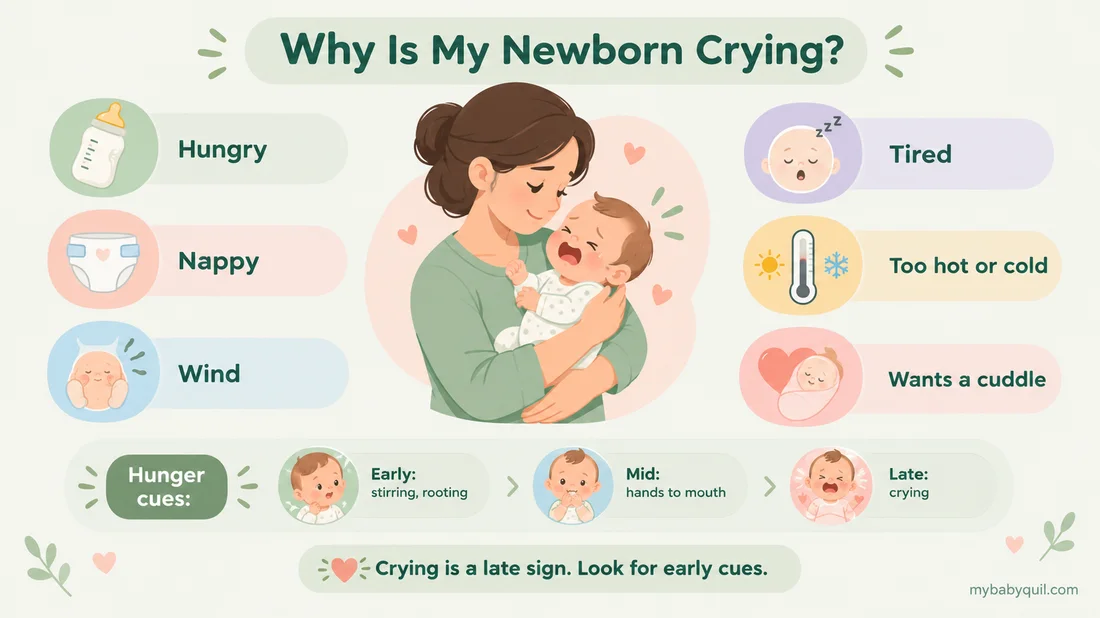
You've fed, changed and cuddled, and still your baby is crying. Almost every new parent has stood in that spot, asking what they are missing. This guide helps you find the likely reason faster, spot hunger and tired signs early, understand how much crying is normal, and know when it is time to get help.
Crying is your newborn's only way to say "something isn't right", and the something can be as simple as a wet nappy or as vague as "I just need you." Babies cry a lot, and it is normal. Sources describe an average of around two to three hours a day, and some babies cry much more.
This guide helps you work out the likely reason, quickly. For soothing methods and colic, see our guide to soothing a crying newborn.
You may have heard that different cries mean different things, such as a "hungry cry" or a "tired cry". The research is less neat than that. A 2025 study from the University of Saint-Etienne, reported in Communications Psychology, recorded almost 40,000 crying episodes from 24 babies, and neither a computer model nor 146 adult listeners could tell the cause from the sound alone, even after training. Parents in the study did guess the cause correctly about three-quarters of the time, but the researchers think this was because of context, such as how long since the last feed or nappy change, not because of the cry itself.
The takeaway is encouraging. You don't have to learn a secret code. You need to think about what has happened in the last few hours, and run through a short list of likely causes.
| Possible cause | Clues | Try first |
|---|---|---|
| Hungry | Rooting, opening the mouth, hands to the mouth, lip smacking. Crying is a late sign. | Feed. If your baby is already upset, calm them with a cuddle or skin-to-skin first |
| Wet or dirty nappy | Wriggling, fussing that eases when changed | Check and change the nappy |
| Wind | Often after feeds, when a baby may squirm or pull up their legs. These signs are not specific to wind | Hold upright and gently rub or pat the back |
| Too hot or too cold | Hot, sweaty or flushed, or cool. Tight or scratchy clothing can also bother them | Adjust layers, check labels and seams, and use a thermometer if you are worried they are unwell |
| Tired | Yawning, clenched fists, jerky movements, a worried look, trouble focusing | Start the settling routine now, before the crying starts |
| Wants closeness | Quiet when picked up, upset when put down | Cuddle, skin-to-skin, or carry in a sling |
| Overstimulated | Turns away, arches, cries after lots of noise, light or handling | Move to a calm, dim, quiet room |
| Unwell | Different from their usual cry, feeding poorly, unusually sleepy or floppy, fever | Seek medical advice, don't wait it out |
These are common reasons babies cry. Sometimes there is no obvious cause, which is normal too.
Crying is a late hunger signal, and a baby who is already upset can be harder to feed. Looking out for earlier signs usually makes feeding calmer. These stages come from Sydney Children's Hospitals Network and NHS Grampian.
| Stage | What you may see |
|---|---|
| Early | Stirring, opening the mouth, turning the head from side to side, rooting, hands to the mouth |
| Mid | More movement and restlessness, stretching, more hand-to-mouth, sucking on lips or hands, lip smacking |
| Late | Crying, agitated movements, and sometimes reddening skin (which may not show on brown or black skin) |
If you missed the early cues, calm your baby first with a cuddle or skin-to-skin, then feed. Watch your baby, not the clock. Feeding patterns shift during growth spurts.
A lot more than most new parents expect. Crying builds from about 2 weeks, peaks around 6 to 8 weeks, often bunches in the evening and eases by about 3 to 5 months. Averages of about two to three hours a day are described, and some healthy babies cry much longer. A baby who feeds well, gains weight and settles between spells is usually going through this normal phase. Our soothing guide covers colic, "PURPLE" crying and what to try when nothing seems to work.
It is stressful, even when you know it is normal. If you reach your limit, put your baby safely on their back in the cot, step away for a few minutes and ask someone to take over. Never shake a baby. Our soothing guide has more on coping and where to get support.
Information is drawn from a peer-reviewed study summary, NHS, health service and children's hospital resources. Check with your own doctor, midwife or child health nurse for advice on your baby.
This page is general information and not medical advice. It does not replace advice from your doctor, midwife or child health nurse. If you think your baby is unwell, get medical help.
The BabyQuil App is free for pregnancy and newborn tracking. Log feeds, sleep and nappies so you can see what happened before the crying started.
Get BabyQuil — free on iOS