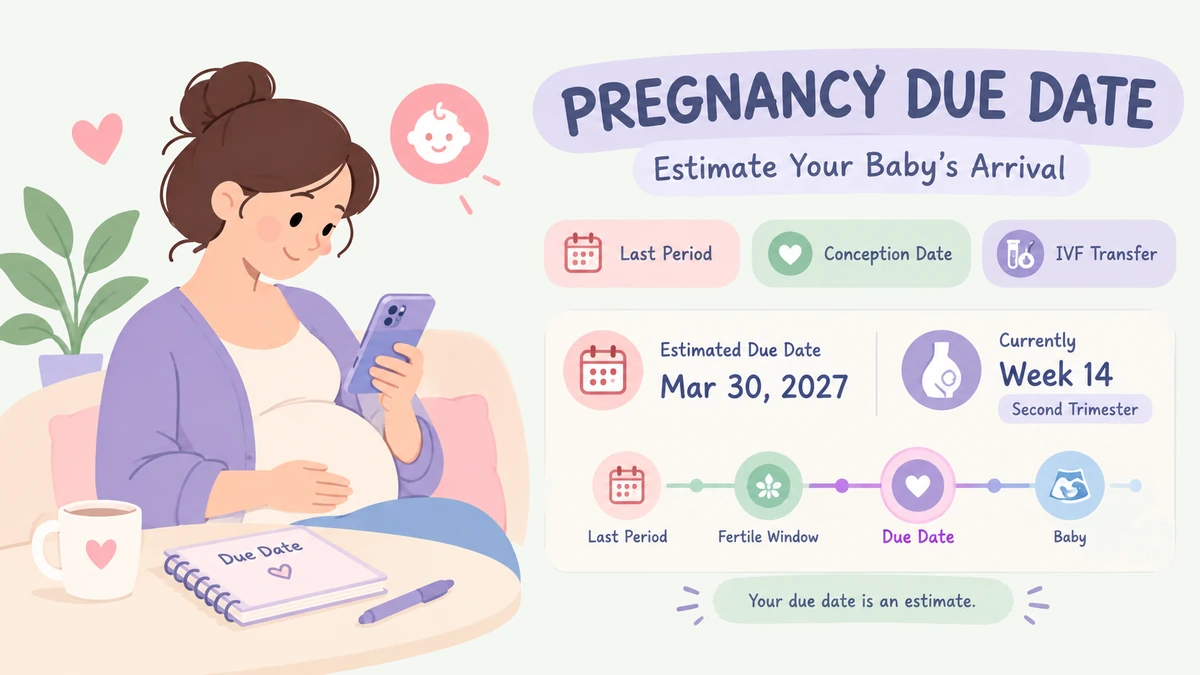
Congratulations on your pregnancy! This tool helps you estimate your due date based on the first day of your last period, your conception date, or your IVF transfer date — just pop in a date and we'll take care of the maths. Currently pregnant and looking for extra guidance and tips to manage and track your pregnancy day to day? The BabyQuil app is for you.
Most due dates are estimated using Naegele's Rule: adding 280 days (40 weeks) to the first day of your last menstrual period (LMP). This assumes an average 28-day cycle with ovulation around day 14 — if your cycle runs longer or shorter than 28 days, adjust the "average cycle length" field above, since a longer cycle shifts ovulation (and your due date) later, and a shorter cycle shifts it earlier.
If you know your conception date instead — for example, from ovulation tracking — your due date is estimated as 266 days (38 weeks) from that date, since conception typically occurs about two weeks after the start of your last period.
For IVF pregnancies, your due date is calculated using the embryo transfer date together with the known age of the embryo at transfer — day-3 (cleavage stage) or day-5 (blastocyst) — which allows gestational age to be established from known treatment dates rather than estimated ovulation.
Your estimated due date (EDD) is an estimate, not an exact prediction. Most babies are not born on their estimated due date, and a full-term pregnancy normally lasts around 37 to 42 weeks from the first day of the last menstrual period.
An early ultrasound can provide a more accurate estimate of gestational age, particularly when your last menstrual period is uncertain or your cycle is irregular. If an ultrasound estimate differs from this calculator, your doctor or midwife can determine which estimated due date is appropriate based on the timing of the scan, your menstrual history, and the ultrasound measurements.
This calculator is for general planning only. Always confirm your due date and any pregnancy concerns with your OB-GYN or midwife, who can adjust the estimate using ultrasound measurements and your individual health history.
Once you have a date, check your antenatal scan schedule, put together your birth plan, start packing your hospital bag, and time contractions with the contraction timer when labor gets close.
This calculator uses the conventional 280-day estimate from the first day of the last menstrual period (Naegele's Rule), adjusted for cycle length, or 266 days from a known conception or IVF transfer date. Pregnancy dating can vary with cycle length, ovulation timing and individual factors — healthcare professionals often use ultrasound to confirm or adjust the estimate.
This calculator provides an estimate for general informational and planning purposes. It does not provide medical advice or diagnose any pregnancy condition. Your doctor, midwife, or other qualified healthcare professional can confirm your estimated due date based on your individual circumstances.
BabyQuil turns this due date into a week-by-week tracker — symptoms, appointments, weight, and contractions, all in one place.
Get BabyQuil — free on iOS