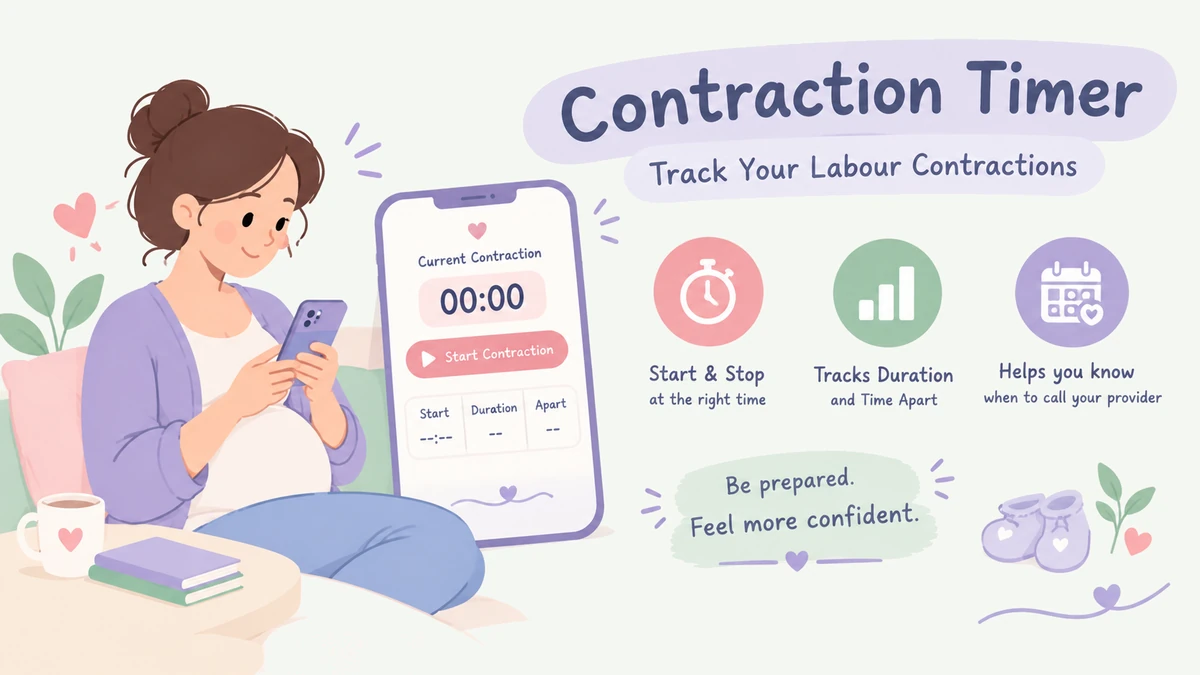
Tap Start when a contraction begins and Stop when it ends. This tracks the duration and calculates how far apart your contractions are, so you can track your pattern and share it with your midwife or doctor. Want this built into your daily tracking? The BabyQuil app has the same contraction timer alongside a kick counter, due date, and everything else.
| Start | Duration | Apart |
|---|
Contact your midwife, doctor, or maternity unit if:
If labor is progressing very quickly and you don't think you'll reach your planned place of birth in time, or you have heavy bleeding, call your local emergency number right away.
As labor progresses, contractions generally become stronger, longer, and closer together. That pattern plays out across three phases of the first stage — every labor is different, so treat the specific numbers below as typical ranges, not a strict timetable:
Every labor is different, and these ranges are typical, not universal — some people move through phases much faster, especially with a second or later baby.
Many providers use "5-1-1" as a general guide: contractions 5 minutes apart, lasting 1 minute each, for at least 1 hour. This pattern is sometimes used as a general guide that labor may be becoming established — contraction timing alone can't confirm what stage of labor you're in. It's a guideline, not a strict rule — always follow your own provider's specific instructions, since they may adjust this based on your history (e.g., a faster labor with a previous birth).
Braxton Hicks contractions are practice contractions your body has throughout pregnancy — sometimes called "false labor." They tone the uterus in preparation for birth, but unlike real labor contractions, they don't open the cervix and aren't a sign that labor has started.
| Braxton Hicks | Real labor contractions |
|---|---|
| Often irregular | Become more regular over time |
| Usually don't get progressively stronger | Generally get stronger |
| Often ease with rest, movement, or hydration | Usually continue despite changing position |
| Don't consistently get closer together | Get closer together over time |
Braxton Hicks can sometimes become fairly regular too, so if you're ever unsure which you're experiencing, it's always fine to call and ask.
Start the timer the moment a contraction begins, and stop it the moment it fully eases — that's the duration. To get the frequency, time from the start of one contraction to the start of the next, not from when one ends to when the next begins. Measuring end-to-start makes contractions look farther apart than they actually are.
A contraction timer can measure timing — it can't tell you whether you're in active labor or whether you or your baby need medical attention. Your midwife or doctor can assess your individual situation and tell you when to come in.
Getting ready for labor? Try the due date calculator, put together your birth plan, pack your hospital bag, see your birthing options ahead of time, and know the warning signs worth watching for throughout.
The 5-1-1 rule and the distinguishing features of Braxton Hicks versus true labor contractions reflect widely used clinical guidance from obstetric providers. Every labor is different — always prioritize your own provider's specific instructions over any general rule.
This timer provides general information and is not a substitute for medical advice. Always follow your doctor's or midwife's specific instructions, and contact them or emergency services directly if you have any concerns during labor.
BabyQuil saves your full contraction history on your device, alongside your due date and pregnancy records.
Get BabyQuil — free on iOS