What is a birth plan?
A birth plan is a short document setting out how you'd like labor, birth and the first moments with your baby to go — who you want with you, how you'd like to manage pain, positions and movement, newborn care and feeding. It's a way to think through your options and start conversations with your care team, not a contract or a script.
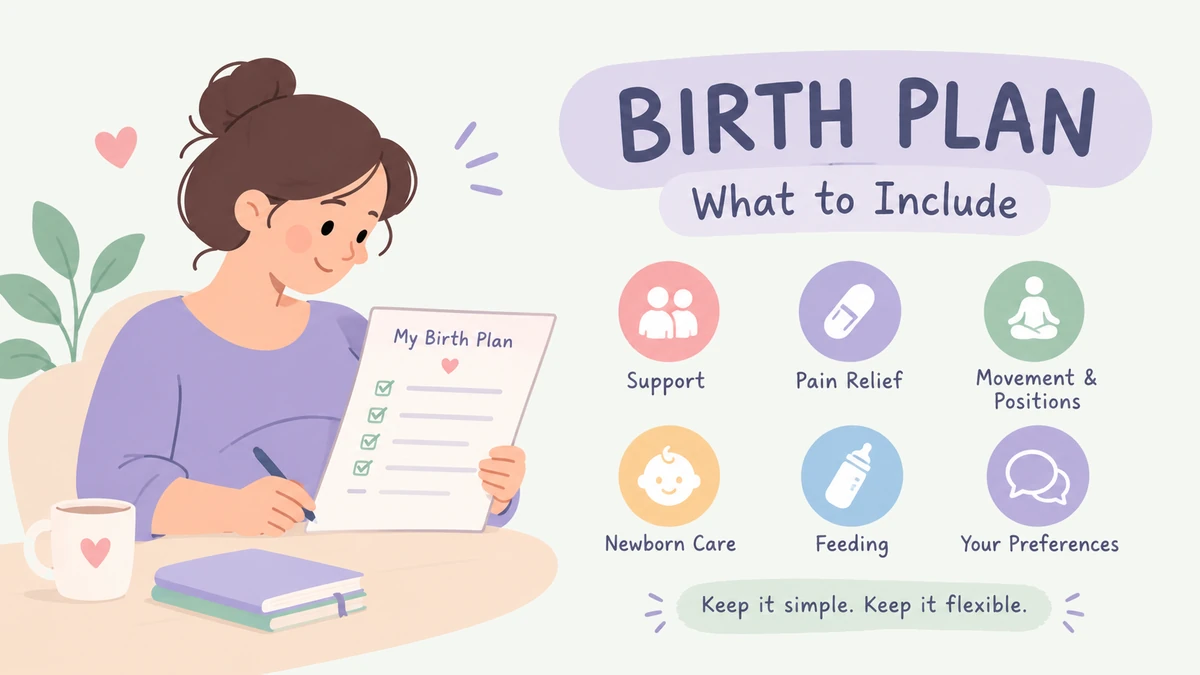
Keep it short and easy to scan
A clear, concise plan is easier for busy staff to scan quickly than a lengthy document. Think of it as a one-page summary of what matters most to you, not a full script.
Talk it through with your provider first
Writing the plan is only half the job. Health services including the National Health Service (NHS) in the UK, Pregnancy, Birth and Baby in Australia, and MedlinePlus and Cleveland Clinic in the US all recommend talking your plan through with your midwife or doctor before labor begins, for example at a prenatal visit. That conversation lets your provider explain what's realistic for your situation, what your hospital or birth center offers by default, and where a preference may not be possible — some hospital policies, and in some places insurance coverage, can limit certain choices. If you find out early that something important to you is a problem, you have time to talk it through and explore your options.
Questions worth asking
- Can I move around and change positions during labor, and is a birthing pool available?
- What does your hospital or birth center do by default for newborns, such as skin-to-skin contact, cord clamping and vitamin K?
- How are induction, assisted delivery and cesarean usually handled, and can my support person stay with me?
- If my preferences need to change, how will I be involved in those decisions?
- Do you accept written birth plans, and how will mine reach the team on the day?
What to include
You won't need every item below — pick the ones that matter most to you, and leave the rest open if you're comfortable deciding in the moment.
- Who you want present — partner, doula, family members, any limits on visitors, whether you'd want someone with you if an assisted delivery or a cesarean turns out to be needed, and how you'd like your support person to help, including helping you communicate your preferences to staff
- Pain management preferences — epidural, unmedicated, or open to deciding in the moment; see our pain management options guide for how each choice actually works
- Movement and setting — freedom to move and change positions, and any facilities you'd like to use, such as a birthing pool, if your setting offers them
- Immediate newborn preferences — skin-to-skin contact, delayed cord clamping, who cuts the cord, and routine newborn care to discuss with your provider, such as vitamin K and newborn screening
- Feeding intentions — breastfeeding, formula, or open to deciding after birth
- A short "if needed" note — what matters most to you if induction, assisted delivery or a cesarean becomes necessary, kept to a line or two and reviewed with your provider
- Who's involved in your care — whether you're comfortable with students or trainees being present
- How you'd like the team to communicate — for example, explaining what they're doing and offering choices where options exist
- Special circumstances — anything specific to your situation (previous C-section, religious or cultural practices, sensory sensitivities)
What to skip
Long, scripted contingency plans for every possible complication tend to add length without adding usefulness — your care team may need to make real-time decisions based on what's actually happening, and an overly rigid plan can lead to disappointment if birth unfolds differently. A short "if needed" note is usually enough. Frame your plan as preferences rather than demands, and it will serve you better either way.
Bring a few copies
If you're giving birth in a hospital or birth center, bring a few printed copies — one for your care team if they accept written plans, one for your support person, and one to keep with your hospital bag. Pregnancy, Birth and Baby suggests taking a written copy along, especially if you won't be seeing the same doctor or midwife throughout, since it gives whoever is caring for you a quick way to see what matters to you. A digital copy on your phone makes a good backup, but don't rely on it alone, since battery and hospital Wi-Fi can't be guaranteed during labor.
Still deciding where to give birth? See birthing options, pack your hospital bag ahead of time, and use the contraction timer once labor begins.