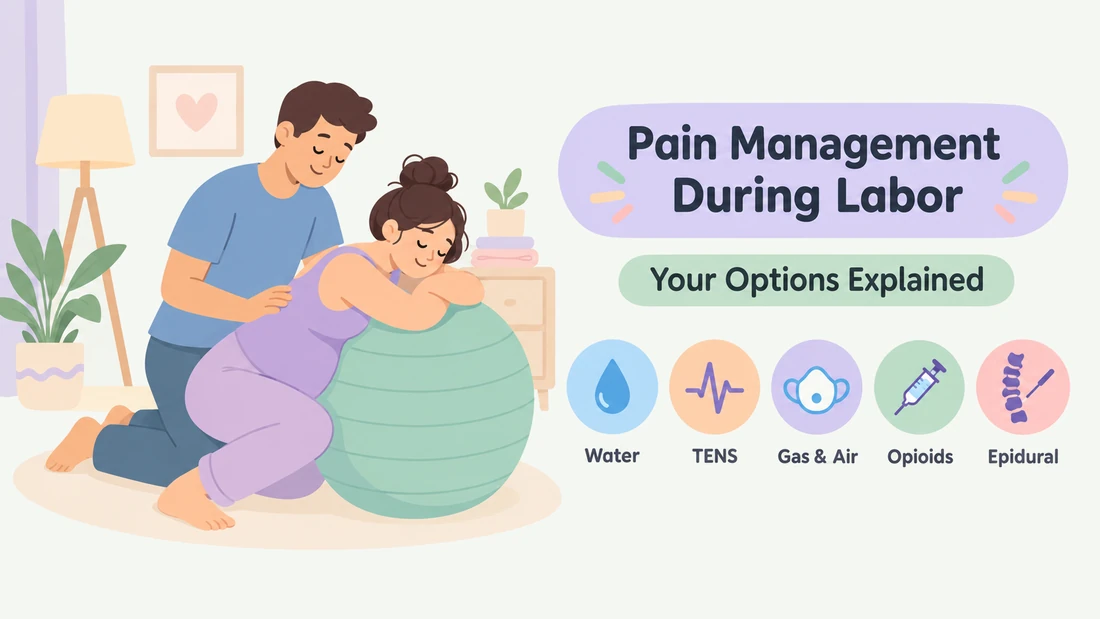
There are a number of non-medical and medical options for pain management during labor. You might use one method, combine several, or change your mind entirely as things progress — and that's completely normal. This page walks you through each one — TENS, water, gas and air, opioids, and epidurals — how it actually works, what the trade-offs are, and when timing matters, with a summary table to compare them at a glance.
These don't involve any medication and can often be combined with each other, though availability can vary between hospitals, birth centers, and home births.
Staying upright and changing positions — walking, swaying, rocking on a birth ball — is one of the simplest things you can do, and it can help manage contractions while also supporting labor's progress. It costs nothing and is simple to try, helping with comfort and coping during contractions.
A bath, shower, or birth pool can ease tension, back pain, and the feeling of pressure, largely through relaxation. One practical note: you generally can't use a TENS machine in the water, and you'll need to wait a full 4 hours after an opioid injection before getting in. If you later choose an epidural, you won't be able to use water immersion or active birth techniques afterward.
A small battery-powered device sends gentle electrical pulses through pads on your back, which seems to ease pain partly by boosting your body's own natural pain-relieving response. It may be more useful when started at the first signs of labor rather than waiting until contractions are already intense, though how well it works varies between people. TENS isn't suitable if you have a pacemaker or spinal rods — check with your maternity team if you're interested in it.
Massage and heat packs can ease back pain and general tension. A partner, doula, or midwife staying with you throughout labor can also provide practical and emotional support — massage, encouragement, and help trying different positions — which is worth factoring into who you want in the room.
These involve medication, and each comes with its own trade-offs worth knowing about in advance.
A mix of nitrous oxide and oxygen, delivered through a mask or mouthpiece that's entirely in your own hands. Because there's a short lag of roughly 15 to 20 seconds before it kicks in, most people find it works best to start breathing it in as soon as they feel a contraction coming on, rather than waiting until it's already underway. It won't remove the pain entirely, but takes the edge off, and you can use it at any stage of labor alongside most other options. It can make you feel lightheaded, nauseous, or sleepy, but these effects pass within a minute or so of stopping.
Given as an injection into your thigh or buttock, these take the edge off pain and can help you relax enough to rest, especially useful earlier in labor. They commonly cause drowsiness and nausea. Because opioids can affect a baby's breathing, alertness, and early feeding, they're usually avoided if birth seems close — your midwife will generally hold off if they think you're nearing the end of the first stage.
An anesthetist places a thin tube into the epidural space in your lower back, through which pain-relieving medication is given, numbing sensation from around your waist down. It's the most effective option for most people, and can typically be given at any point in labor as long as an anesthetist is available — though it takes around 20 to 40 minutes to set up and start working, so it's not instant. Because it requires an anesthetist, it's only available in a hospital, which means it's not an option for planned home birth and isn't offered at every birth center — see our birthing options guide for what's typically available where. Once you have an epidural, you won't be able to use water immersion or active birth techniques for pain relief afterward, and you'll need more continuous monitoring of your baby's heart rate and your blood pressure. It doesn't always give complete relief — some people need a top-up or additional pain relief — and it's linked to a longer second stage of labor and a higher chance of needing an assisted delivery, though current evidence doesn't link it to a higher chance of cesarean birth. Other possible effects include difficulty urinating (sometimes needing a temporary catheter) and, less commonly, a headache afterward.
Maybe the most useful thing to know going in: you're not locked into one choice. Plenty of people plan an unmedicated birth and end up with an epidural, or plan to use an epidural and find gas and air is all they need — neither is a failure of planning, and it's genuinely common to combine methods or change course as labor unfolds. It's worth thinking through your preferences and noting them in your birth plan, but worth holding them loosely too. It's also worth checking in advance that your preferred options are actually available wherever you're planning to give birth, since not every method is offered everywhere.
Thinking this through ahead of time? See your birthing options, build your birth plan, and pack your hospital bag — then use the contraction timer once labor begins.
| Option | Type | Worth knowing |
|---|---|---|
| Movement & position changes | Non-medical | Free, no downside, available anywhere |
| Water (bath, shower, pool) | Non-medical | No TENS in water; wait 4 hours after opioids; not after an epidural |
| TENS machine | Non-medical | May help more if started early; not with a pacemaker |
| Massage & heat | Non-medical | Eases tension and back pain |
| Gas and air (nitrous oxide) | Medical | Usable any stage; takes the edge off, not full relief |
| Opioids (pethidine & similar) | Medical | Best earlier in labor; avoided close to delivery |
| Epidural | Medical | Most effective option; hospital only; rules out water/movement after |
What's actually available depends on where you give birth and your individual circumstances — this table is a starting point for the conversation with your provider, not a guarantee of what you'll be offered.
This page draws on guidance from the NHS, the American College of Obstetricians and Gynecologists, and Pregnancy, Birth and Baby, an Australian Government health information service. Which pain relief options are available to you depends on where you give birth, your individual circumstances, and your provider — always discuss your own options with your doctor or midwife.
This page provides general information and is not a substitute for personalized medical advice. Which pain relief options are suitable, safe, and available to you depends on your individual circumstances — discuss your options with your doctor or midwife.
BabyQuil's doctor's notes feature lets you jot down your pain relief preferences and questions ahead of time, alongside your due date and pregnancy records, so you don't forget to raise them.
Get BabyQuil — free on iOS