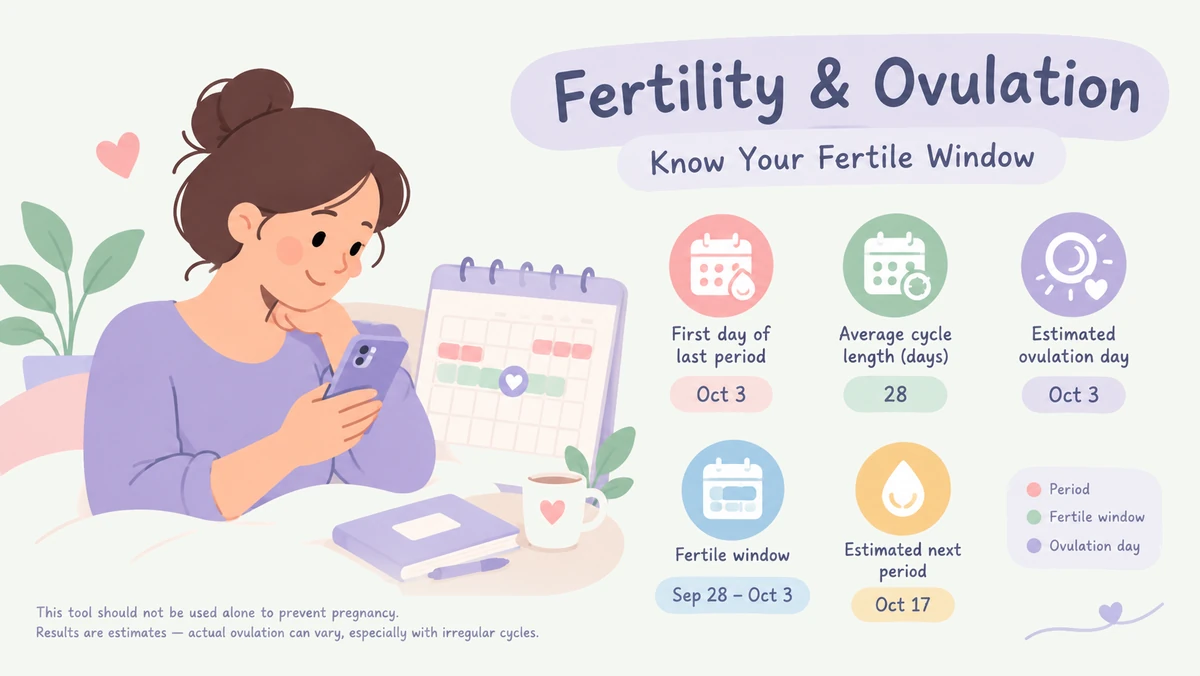
Trying to conceive is an exciting journey, and knowing your fertile window can make all the difference. This tool estimates your most fertile days based on the first day of your last period and your average cycle length — just pop in your dates and we'll take care of the maths. Looking for extra guidance and tools to support your journey to conceive? The BabyQuil app is for you.
This tool should not be used alone to prevent pregnancy. Results are estimates — actual ovulation can vary, especially with irregular cycles.
Ovulation typically occurs about 14 days before your next period starts, regardless of your total cycle length. So for a 28-day cycle, ovulation is usually around day 14; for a 32-day cycle, closer to day 18. Your fertile window is generally the 5 days before ovulation plus the day of ovulation itself, since sperm can survive up to 5 days in the body while the egg survives only 12-24 hours after release.
This calculator works best for regular cycles (21-35 days). If your cycles vary significantly month to month, this estimate will be less reliable — tracking basal body temperature or using an ovulation predictor kit over a few cycles will give you a clearer picture. If you've been trying to conceive for a while without success, it's worth discussing with your doctor.
Think you might be pregnant? See how pregnancy tests actually work and when to take one. Once you've conceived, use the due date calculator to estimate your delivery date, or check the contraction timer when the time comes.
This calculator estimates ovulation using the standard luteal-phase-constant method: ovulation is assumed to occur 14 days before your next period, regardless of total cycle length, since the luteal phase varies far less than the follicular phase. The fertile window reflects typical sperm survival (up to 5 days) and egg viability (12-24 hours after release).
This calculator provides an estimate for general informational and planning purposes. It does not provide medical advice, diagnose any condition, or serve as a method of contraception. Your doctor or midwife can advise you based on your individual cycle and health history.
BabyQuil keeps your due date and pregnancy records together in one place, from the moment you conceive.
Get BabyQuil — free on iOS