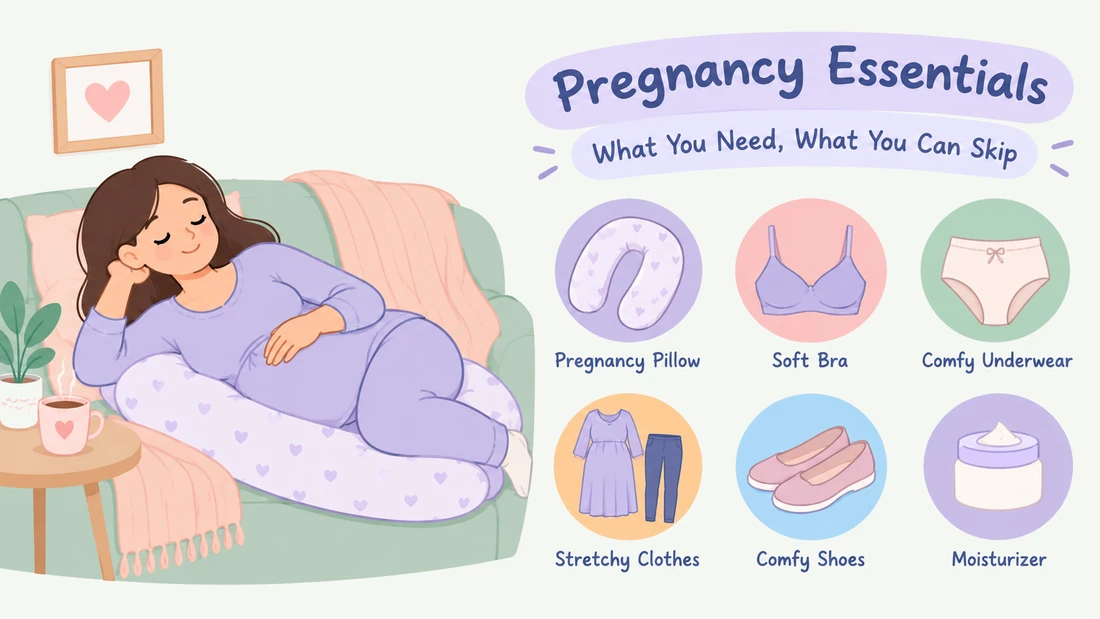
Within a few days of a positive test, your feed fills up with lists of things every expecting parent supposedly "must" buy. Here's the calmer version. Most of what makes pregnancy more comfortable is simple, plenty of it can be borrowed or bought secondhand, and a few popular items aren't worth your money at all. This guide covers pillows, bras, underwear, clothing, shoes, supports, and skin care — what's backed by good advice, what's simply nice to have, and what to skip — with a summary table to keep it all straight. We don't recommend specific brands, only what to look for.
| Item | Helps with | When you might want it | Worth knowing |
|---|---|---|---|
| Pillows (regular or pregnancy pillow) | Making side-sleeping more comfortable | Mainly later in pregnancy | A comfort aid, not a must-buy. The advice is about going to sleep on your side from the third trimester. |
| Soft, supportive bra | Tender, growing breasts | From early pregnancy if your bras feel tight | Fit changes over time; nursing bras can wait until late pregnancy. |
| Comfortable underwear | Comfort as your body changes | Whenever your usual pairs get uncomfortable | Loose cotton may help prevent thrush; any comfortable style is fine. |
| Stretchy clothes and layers | Room to grow and changing temperature | When your regular clothes stop being comfortable | Buy as you need; borrowing and secondhand work well. |
| Comfortable shoes | Swollen feet | Especially later in pregnancy | Avoid tight straps. Sudden or severe swelling, especially with a headache or vision changes, needs attention. |
| Support belt | Pelvic girdle pain, for some people | Only if you have pelvic or back pain | Can help some people with pelvic girdle pain; research is limited. Ask your midwife or physiotherapist about fit and how long to wear it. |
| Compression stockings | Heavy or swollen legs | Later pregnancy, if recommended | Evidence is limited; ask your provider whether they're right for you, especially if you're at higher risk of blood clots. |
| Moisturizer | Dry or itchy skin | Whenever you like | Doesn't prevent stretch marks. Avoid products containing retinoids. |
| Home heartbeat Doppler | Listening to your baby at home | Skip it | Can give false reassurance. Contact your provider about any concern instead. |
Every pregnancy is different — treat this as a starting point, not a shopping list. If something hurts or worries you, talk to your midwife or doctor rather than buying your way out of it.
Sleep tends to get harder as your bump grows, and a pillow or two can help. A dedicated pregnancy pillow — the long, U-shaped, C-shaped, or wedge styles — is a comfort choice rather than a medical one. A few ordinary pillows can do the same job, so there's no need to buy one unless you'd like to.
What does matter is position. The charity Tommy's advises going to sleep on your side from the third trimester (after about 28 weeks), because research has linked going to sleep on your back at that stage with a higher risk of stillbirth. Either side is fine, and the advice covers daytime naps too. Australian guidance from Safer Baby and Red Nose says the same, and stresses starting every sleep on your side. Pillows are a handy way to make it stick: one behind your back to stop you rolling over, one under your bump, and one between your knees. If you wake up on your back, don't worry — simply roll onto your side and settle back to sleep. Tommy's adds that there's no need to stress: if your pregnancy is uncomplicated your risk is low, and going to sleep on your side lowers it further.
If you have pelvic pain, keeping your knees level with a pillow between them can make side-sleeping more comfortable.
Breast tenderness and growth are often among the first changes, so a bra that felt fine before may start to dig in early on. Look for something soft, stretchy, and adjustable that can adapt to a growing ribcage and breasts, and don't be surprised if you need to be re-measured more than once. Wire or no wire is largely a comfort call — what matters is that nothing presses or squeezes your breasts.
Nursing bras can wait, and you don't need one at all if you'd rather wear ordinary soft bras. If you'd like one, the timing advice varies a little. The UK charity NCT says a bra bought from around 28 weeks should still fit after the birth, though some people need a bigger cup size in the early weeks. National Health Service (NHS) Grampian in Scotland suggests waiting until the last month of pregnancy, then getting re-measured about six weeks after your baby arrives. Starting with one or two is a sensible way to see how your size settles.
Wear whatever feels comfortable — there's no medical rule about style, so over-the-bump and under-the-bump cuts are both fine as long as nothing digs in. One piece of advice does come from the NHS: increased vaginal discharge is a normal part of pregnancy, and wearing loose cotton underwear may help prevent thrush (avoiding perfumed soaps and bath products may also help). Thrush is easily treated, but check with your doctor, pharmacist, or midwife first, since some thrush medicines aren't suitable during pregnancy. And if your discharge looks or smells different from usual, or you're itchy or sore, it's worth mentioning to your provider.
You won't need a whole new wardrobe, and there's no rule about when to start maternity wear. Many people get by for a while with stretchy leggings, looser tops, and dresses, then move to maternity pieces when their regular clothes stop being comfortable — which varies a lot from person to person. Buying as you need, rather than by trimester, is usually kinder to your budget, and borrowing or buying secondhand works well for clothes you'll only wear for a few months. Layers make it easy to adjust if your temperature changes through the day.
Fabric can matter more than label. If your skin gets itchy, the Leeds Teaching Hospitals NHS Trust suggests loose clothes and natural fabrics like cotton rather than synthetics. Severe or unusual itching, especially on your hands and feet, is a different matter — see the warning signs in our pregnancy symptoms guide.
Feet and ankles often swell, especially later in pregnancy and toward the end of the day. The NHS suggests wearing comfortable shoes and socks and avoiding tight straps or anything that might pinch if your feet swell. Keep an eye on the pattern, though: mild swelling is common, but sudden swelling of your face or hands, especially with a severe headache or vision changes, needs prompt medical assessment, as does pain and swelling in just one leg — our pregnancy symptoms guide has the details.
A maternity support belt is designed to support your pelvis and is mainly used for pelvic girdle pain. NHS Fife advises wearing one during activities you find painful, like walking or housework, rather than for long periods or while sleeping. Research on support garments is limited — a systematic review found most studies use them alongside other treatments — so they're best seen as one option among several. If you have pelvic or back pain, ask your midwife or a physiotherapist before buying one; they can also suggest other things that help.
Compression stockings are often suggested for heavy, tired, or swollen legs, but the research is thinner than the marketing. A Cochrane review of treatments for varicose veins and leg swelling in pregnancy concluded there isn't enough evidence to give clear guidance on any one approach, and an earlier version of the review found one small trial with no clear difference in leg swelling between stockings and simply resting. Some people still find them supportive. If you're at increased risk of blood clots, ask your maternity team whether compression stockings or another prevention strategy is right for you, and if you do try a pair, ask your provider or pharmacist about the right fit. A red, painful, or swollen leg on one side is not a comfort problem: it needs medical assessment, not a home fix.
Stretch marks affect somewhere between 50% and 90% of pregnancies and usually fade to pale lines after birth. Cochrane reviewed the research on creams and oils and found no high-quality evidence that any of them prevent stretch marks. A moisturizer can feel lovely on tight or dry skin if you enjoy using one, but it isn't insurance.
One ingredient family is worth checking labels for: retinoids (including retinol and tretinoin), found in many anti-aging and acne products. Mayo Clinic advises avoiding topical retinoids during pregnancy even though only small amounts are absorbed through the skin, and notes that oral isotretinoin is known to cause birth defects; the teratology service MotherToBaby gives the same advice. Because retinoids are sold with and without a prescription, read labels carefully. If you've used a retinoid product, don't panic — experts quoted by ABC News say a little accidental use isn't a reason for alarm — but stop using it and discuss the product and timing with your doctor, midwife, or pharmacist, who can also suggest pregnancy-safe options for acne or pigmentation.
A heartbeat heard at home can't tell you whether your baby is well. If you're concerned about your baby's movements or wellbeing, contact your midwife, doctor, or maternity service instead.
Changes in your baby's movements are one of the warning signs listed in our pregnancy symptoms guide.
Hand-held Doppler devices that let you listen to your baby's heartbeat at home are heavily marketed, but Tommy's strongly advises against them. It's easy to mistake your own pulse or the blood flow in your placenta for your baby's heartbeat, and even a genuine heartbeat is only a snapshot in time, so it can falsely reassure someone whose baby's movements have actually changed. The Royal College of Obstetricians and Gynaecologists (RCOG) in the UK and the US Food and Drug Administration (FDA) also discourage home use.
More broadly, be cautious about any gadget or app that claims to monitor your baby's wellbeing at home — Tommy's notes there's little regulation of devices and apps sold for home use.
Antenatal care · support · rest · reliable information · knowing when to ask for help
The most important pregnancy "essentials" aren't products. Regular antenatal appointments (see our antenatal scan schedule and antenatal tests guides), any supplements your doctor or midwife recommends, and people who can help when things feel heavy matter more than anything above. When you're ready for the next stage, our hospital bag checklist covers what to pack, and the due date calculator helps you plan the weeks ahead.
This guide draws on UK, US, and Australian health information, and on Cochrane systematic reviews where they exist. Where sources differ — for example on when to buy a nursing bra — we've said so rather than picking one. Evidence for many comfort items is limited, and we've tried to say that plainly. We don't recommend specific brands.
This page provides general information and is not a substitute for personalized medical advice. Talk to your doctor or midwife before using any supplement, supportive garment, or skin product if you have a medical condition or any concerns.
BabyQuil's hospital bag checklist keeps your packing list alongside your due date and appointments, and the health and mood log is a handy place to note comfort issues to raise at your next visit.
Get BabyQuil — free on iOS