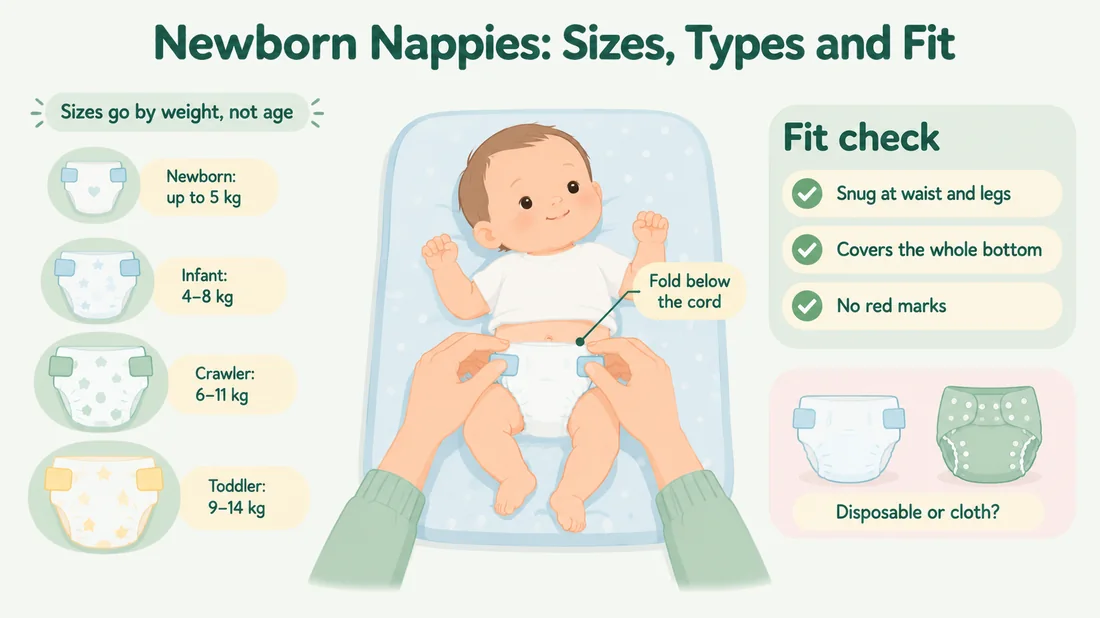
Walk into a baby shop and the nappy aisle is a wall of sizes, brands and claims. This guide explains disposable and cloth, how sizing really works, how to tell if a nappy fits, how many to buy and what to watch for in the first weeks. Nappy is the Australian, New Zealand and UK word, and diaper is the American one. The advice is the same.
Start with one small pack of newborn size, choose by the weight range on the pack, and check the fit: snug at the waist and legs, full coverage and no red marks. Expect many changes a day. This is general information, not medical advice. If something worries you, talk to your midwife, child health nurse or doctor.
| Your question | The short answer |
|---|---|
| Which type should I start with? | Either works. Many parents begin with disposables for convenience, then add cloth later, and some switch between the two. |
| How many nappy changes a day? | Young babies may need as many as 10 or 12 a day, so expect a lot of nappies in the early weeks. |
| How often should I change? | Check often and change promptly when wet or soiled, especially after a poo. Young babies may need 10 to 12 changes a day. |
| What size do I buy first? | Most newborns start in the newborn size (size 0 or 1), which suits babies up to about 5 kg. Check the weight range on the pack. |
| How do I know the size is right? | It covers the bottom, sits snugly at the waist and legs, and leaves no red marks. Check the weight range on the pack. |
| Should I stock up on newborn size? | Buy a small pack first. Babies grow quickly, and sizes differ between brands. |
| What goes near the belly button? | Fold the nappy below the cord stump, if the weather isn't cold, so it can dry. |
| Wipes or water? | Plain water on cotton wool is gentle and cheap. If you use wipes, choose fragrance-free ones. |
| When do I need a doctor? | Pale, white or clay-coloured poo (get advice promptly), blood in the poo, a red or tender belly button, or a rash that doesn't improve within a week. |
In Australia, New Zealand and the UK the word is nappy. In the US and Canada it is diaper. They are the same product, and the choices are the same: disposable or cloth, which size, and how to get a good fit. Most of the advice below applies anywhere. Where a number comes from an Australian or UK health source, the text says so.
Pregnancy, Birth and Baby describes disposables as designed for one use and then thrown away. It says cloth nappies are generally kinder to the environment and can save money over the long run, but they take more time to wash, some fabrics dry slowly and they cost more upfront. The NHS also says disposables are convenient, while cloth nappies usually cost less across the years a baby wears nappies.
| Disposable | Cloth | |
|---|---|---|
| Cost | Cost more over time | Cost more upfront, usually less over the years |
| Convenience | Compact and easy to use and bin | More washing and slower drying for some fabrics |
| Absorbency | Often more absorbent, so fewer leaks | May be less absorbent, so more clothing and bedding changes |
| Environment | Adds to landfill | Generally kinder to the environment |
| Newborn fit | Newborn sizes are widely available | Many one-size nappies suit about 4 to 5 kg and up, so check the fit |
You do not have to pick one for good. Pregnancy, Birth and Baby notes that many parents switch between types as their baby grows, depending on travel, laundry access, bin access and cost. Some cloth brands and councils offer trial packs or samples, and the NHS mentions that a nappy laundry service can collect dirty cloth nappies and deliver a fresh batch each week.
Cloth nappy care. The NHS says cloth nappies can be machine washed at 60°C, but follow your nappy maker's instructions for temperature and detergent. The NHS also advises against fabric conditioner because it makes them less absorbent. It also notes that fabric conditioner can lead to nappy rash. Fitted nappies need a leak-proof cover, according to Pregnancy, Birth and Baby.
A lot. The NHS says young babies may need changing as many as 10 or 12 times a day, and older babies about 6 to 8 times. At 10 changes a day, that is around 70 nappies a week. Babies do 2 or more poos a day in the first week, and formula-fed newborns may poo up to 5 times a day, the NHS says.
Frequency is not the same for every baby. Pregnancy, Birth and Baby says it depends on how often your baby wees and poos and how they feed, and suggests changing every 3 to 6 hours or straight after a poo. Do not treat that as an interval to wait out: change a wet or soiled nappy promptly, because prolonged contact can make skin sore and red. The Royal Children's Hospital (RCH) gives a lower figure of roughly five to seven changes a day for babies under 12 months, which is a reminder that these are ranges, not rules.
Queensland Children's Health uses nappy output to show whether a breastfed newborn is getting enough milk. The figures below are a guide only, and the fact sheet says wide variation is normal.
| Baby's age | Wet nappies in 24 hours | Poo |
|---|---|---|
| Day 1 | At least 1 | Sticky, green-black |
| Day 2 | At least 2 | Soft, green-black |
| Day 3 | At least 3 | Greenish-brown |
| Day 4 | At least 4, pale or clear wee | Lighter greenish-brown or brown-yellow |
| Day 5 onwards | 5 or more, pale or clear wee | 3 or more soft or liquid, mustard-yellow |
If wee is pink or orange after day 3, or green-black poo is still present on day 5, the fact sheet says to contact a child health nurse or GP, because it can be a sign of poor feeding. See also our newborn feeding gear guide and formula feeding guide.
Track nappies in the BabyQuil app. In the first weeks it is hard to remember who had how many wet and dirty nappies. You can log them in the free BabyQuil App alongside feeds and sleep, and show the log to your midwife, child health nurse or doctor. The app is a record-keeping aid. It cannot tell you whether feeding is going well, so talk to a health professional if you are worried.
Nappy sizes are set by weight. Brands use different labels: numbers (0, 1, 2, 3), or names such as Newborn, Infant, Crawler, Toddler and Walker. The table below is an illustrative guide, not a universal standard. It lines up the usual sizes with typical weights, who wears them and roughly how long an average baby is at that stage. Length is shown for orientation only, because no brand we checked sizes by height. Those figures come from the World Health Organization (WHO) growth standards, which the BabyQuil growth calculator uses, and individual babies vary.
| Common size name | Weight range on the pack | Who usually wears it | Approx. length of an average baby |
|---|---|---|---|
| Premmie or size 0 | Under about 3 kg | Small or premature babies, and some babies born under about 3 kg | About 45 to 50 cm |
| Newborn or size 1 | Up to about 5 kg | Most newborns, from birth to around 6 weeks or 2 months | About 49 to 57 cm |
| Infant or size 2 | About 4 to 8 kg | Babies from around 1 to 6 months | About 54 to 68 cm |
| Crawler or size 3 | About 6 to 11 or 12 kg | Babies from around 4 months, through rolling and crawling, to about 14 months | About 62 to 78 cm |
| Toddler or size 4 | About 9 to 14 or 15 kg | Babies from around 9 months into toddlerhood | About 72 cm and up |
Where the numbers come from. The weights are the ranges published by Huggies and BabyLove in Australia and by Pampers in the UK. The ages come from the Australian brand Ecoriginals, which publishes approximate ages. Treat everything as approximate: brands overlap and change their ranges, so the same baby can be a different size in different brands.
Which size first? The WHO median birth weight is about 3.3 kg for boys and 3.2 kg for girls, and most healthy babies are born between about 2.5 and 4.3 kg. So most newborns start in the newborn size (size 0 or 1, depending on the brand). Pampers notes that a larger baby may not need size 0 at all, and suggests size 2 for a baby of around 4 to 5 kg. If your baby is between sizes, check the fit rather than the label alone.
The Absorbent Hygiene Product Manufacturers Association (AHPMA), an industry body, suggests sliding two fingers under the waistband: if you cannot, the nappy is too tight. A good fit generally looks like this:
Time to size up? According to the AHPMA, consider moving up if the nappy does not cover the bottom, leaves red marks, or your baby has nappy rash. If leaks are the only problem, try a more absorbent nappy in the same size first.
The NHS describes a simple routine:
Disposal. For disposables, the NHS says to roll up the used nappy, reseal it with the tabs, bag it and put it in an outside bin. Pregnancy, Birth and Baby warns that nappy disposal bags are a suffocation risk, so keep them out of your baby's reach.
The RCH says nappy rash is caused by constant moisture from wee and poo plus friction, and that bacteria, yeast, detergents or wipes can make it worse. Most nappy rash clears within a couple of days with barrier cream and good care.
Not always. Brands name and size their ranges differently, so go by the weight range printed on the pack rather than the name.
Not necessarily. Some babies fit into the next size from birth, and some are in newborn size for weeks. A small pack is a good compromise.
Not by default. The right fit and the right absorbency for your baby matter more than the price. Compare the cost per nappy, and try a sample before you commit.
Many health sources prefer water and cotton wool at first. The NHS says you can use cotton wool with plain warm water, or fragrance-free and alcohol-free baby wipes. The RCH advises avoiding baby wipes when treating a rash. If your baby has sensitive skin, water is the simplest option.
It can contribute, because moisture and friction irritate skin. The RCH notes that good-quality disposable nappies are recommended for managing rash because they absorb moisture better than cloth. Cloth users can still prevent rash with prompt changes and thorough rinsing.
Use the table above as a rough guide for breastfed babies, and speak with a child health nurse, lactation consultant or GP if something looks off or you are unsure.
Information is drawn from Pregnancy, Birth and Baby, the NHS, the Royal Children's Hospital Melbourne, Queensland Children's Health, the WHO growth standards, an industry fitting guide (AHPMA) and manufacturer size guides, which can change.
This page is for general information and does not replace advice from your midwife, child health nurse or doctor.
The BabyQuil App is free for pregnancy and newborn tracking. Log wet and dirty nappies alongside feeds and sleep, and share a report with your doctor or nurse.
Get BabyQuil — free on iOS